
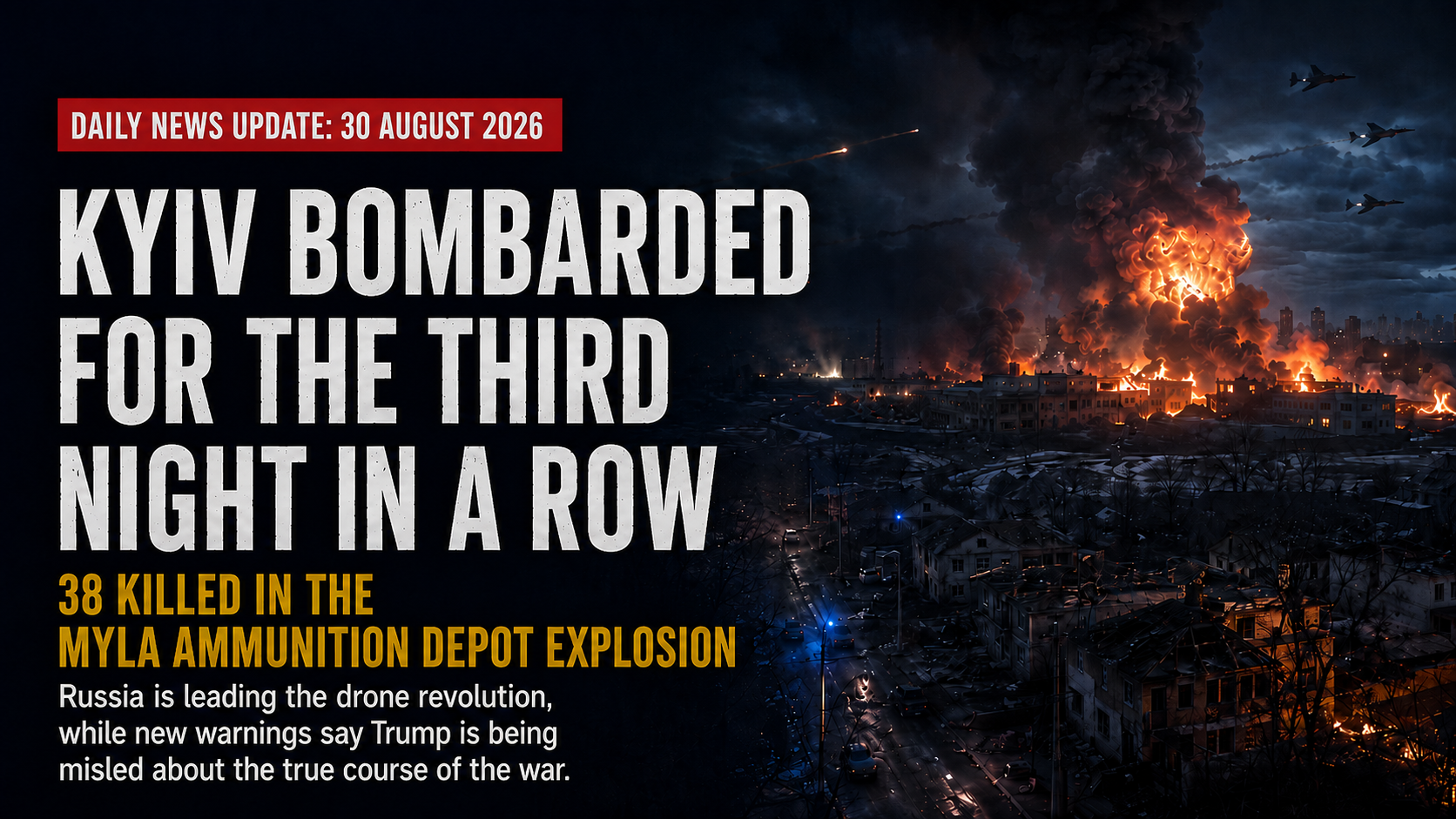
An Ammunition Depot in the Middle of a Residential Area — and Civilians Pay the Price
On the night of 28 August, a Russian jet-powered Geran-4 drone struck a warehouse complex in the village of Myla in the Bucha district west of Kyiv. What followed were hours of massive secondary explosions — fireballs flying hundreds of metres, fires spreading to nearby homes, and the evacuation of more than 380 residents. At least 38 people have been confirmed dead. At least 50 residential buildings were damaged, and a care facility for the elderly and disabled was hit by the detonations.
The Russian Defence Ministry confirmed that the strike targeted the FIM Service transport and logistics centre in the Chaiky suburb, where Ukrainian Flamingo cruise missiles and related components were being stored. Ukraine’s Prime Minister Serhii Koretskyi himself drew a comparison with the similar explosion in Vyshneve a few weeks earlier and called it “the same mistake for the fifth year in a row” and “criminal negligence”. Zelensky confirmed the death toll on Saturday and promised prosecutions of those responsible for the dangerous storage of explosives near civilian homes.
It needs to be stated clearly: military ammunition depots are, as a rule, legitimate military targets. At the same time, the defending party has an obligation, as far as practically possible, to avoid placing military objectives in or near densely populated areas. It was the Ukrainians — not the Russians — who were responsible for that choice of location. Zelensky’s promise of prosecutions is appropriate — but it should be directed at those who chose to store Flamingo missiles in a suburb, not at those who attacked them.
Three Days of Continuous Strikes on Kyiv: A New Era
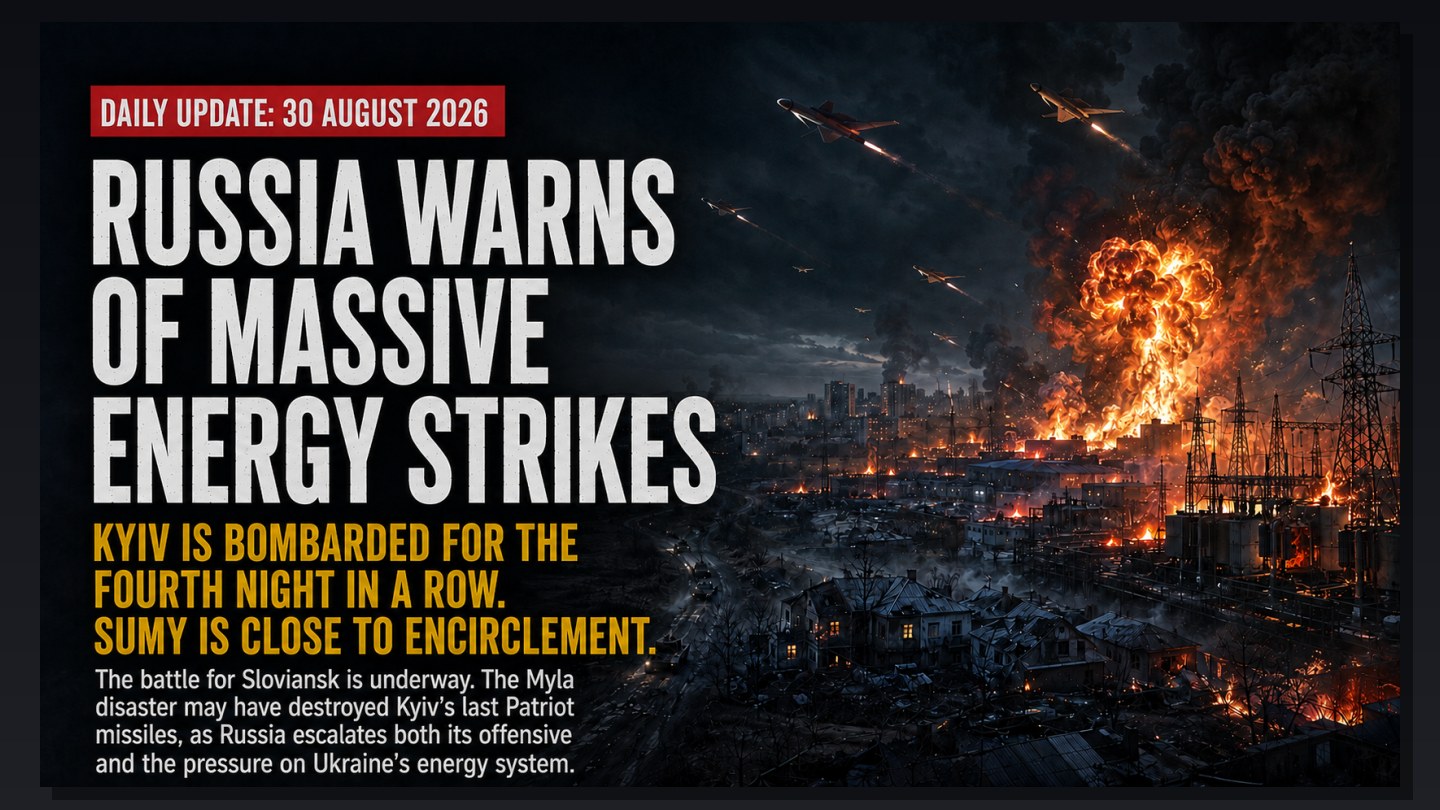
Kyiv is now entering its third consecutive night of Russian missile and drone attacks. This is a pattern we have not previously seen in the war. Russia is now keeping Kyiv under sustained pressure — not merely isolated, sporadic strikes, but a systematic multi-day campaign against military-industrial facilities, logistics centres and storage sites in and around the capital.
This is approaching what military analysts would call a genuine air campaign — coordinated, sustained and of an intensity reminiscent of the major American bombing campaigns during the Gulf War of 1990–1991. Against a country that barely has a functioning air-defence system left.
Russia is now primarily using jet-powered Geran-4 and Geran-5 drones over Kyiv — not the propeller-driven Geran-2 variants that operate along pre-programmed routes. The Geran-4 and Geran-5 operate at high subsonic speeds and have electro-optical guidance — they can be directed by ground operators in real time, either through Belarusian relay stations along the Ukrainian border or through the expanding Rassvet satellite system. These are drones that, in practice, function as cheap cruise missiles with live human guidance. Ukraine’s existing air defences — machine guns and older systems — are not designed to stop them consistently.
Of the latest PAC-3 interceptors fired since this attack cycle began four days ago, between three and eight launchers have been recorded — probably from a small reserve stock either recently delivered by a NATO country or carefully kept hidden. Since then: nothing. Kyiv effectively has no anti-ballistic defence capability. The US Embassy in Kyiv has now issued a formal warning advising American citizens against travel to Ukraine and imposing strict restrictions on the presence of diplomats’ family members in the country.
Medvedev: Russia Is the World Leader in Drones — and Can Prove It
Dmitry Medvedev — deputy chairman of Russia’s Security Council and head of the Military-Industrial Commission — said something this week that deserves to be taken seriously. He said that Russia went from virtually zero drone capability five years ago to becoming the world’s undisputed leader in drone warfare today. It has incorporated AI technology into its drones, possesses them in greater quantities than any other state, and coordinates them in ways no other state can match. He speaks on the subject with authority, he said, because as head of the Military-Industrial Commission this is his daily work.
It is difficult to refute empirically. Russia began the war with primitive drone capabilities and was outcompeted by Ukrainian drone innovation in 2022–2023. It learned quickly, adapted and applied enormous industrial and research pressure. Geran-4 and Geran-5 are now operational, the Arena system protects armoured forces against Ukrainian anti-tank drones, and the Rassvet system is beginning to provide Russian drones with long-range real-time guidance.
That is not propaganda.
It is operational reality.
VIPS to Trump: You Are Being Misled About the War
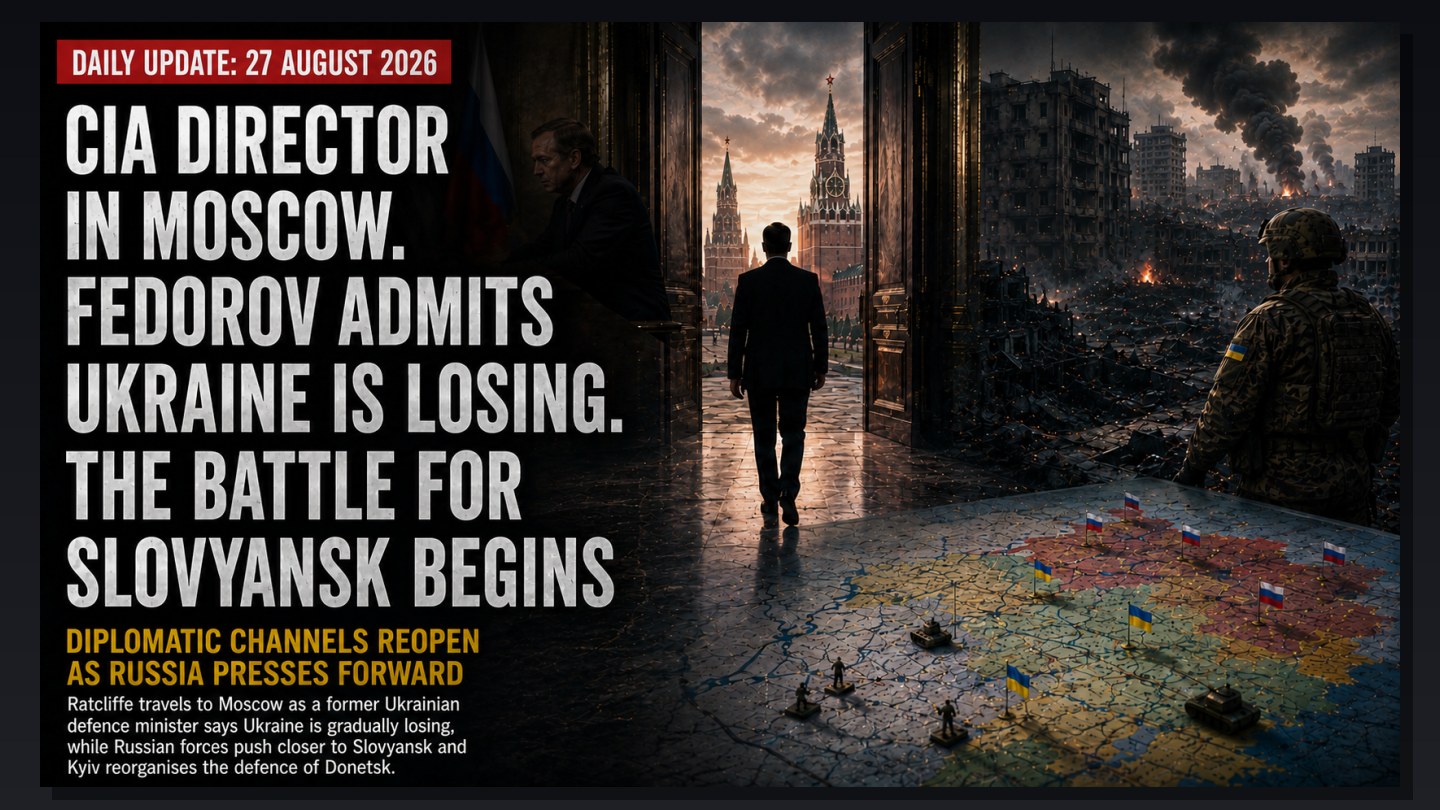
Veteran Intelligence Professionals for Sanity — the organisation bringing together retired senior officers and officials from the CIA, NSA and other US intelligence agencies, including Larry Johnson, Ray McGovern and William Binney — published an open report addressed directly to President Trump this week, warning him that the information he is receiving about the military situation in Ukraine is fundamentally wrong. The report, published by Consortium News, is a direct rebuttal of the New York Times article claiming that Ratcliffe travelled to Moscow to correct Putin’s mistaken assessment of how the war is progressing.
The VIPS analysis is clear: it is not Putin who has been given a false picture of the war.
It is Trump.
The narrative of Ukrainian progress in the air, Russian manpower exhaustion and sanctions working — all of this, according to VIPS, is false information making its way into the Oval Office through a combination of Ukrainian propaganda, European interest management and the institutional bias of intelligence systems toward telling the boss what he wants to hear.
These men are worth listening to. They are the same people who warned against the invasion of Iraq in 2002. They are the same people who warned against the intervention in Libya in 2011. They are the same people who warned that there was no evidence of weapons of mass destruction.
They were ignored then.
There is little to suggest anyone is listening to them now either.
SCO Summit: Putin and Xi, and Power of Siberia 2
Over the next few days, the Shanghai Cooperation Organization will gather in Kyrgyzstan. Putin and Xi Jinping will meet, and Russian media report that the two leaders are expected to finalise the Power of Siberia 2 gas pipeline agreement — a project that will bind Russia and China together in energy terms for the long term and send large quantities of Russian natural gas to China through a new pipeline via Mongolia. Rosneft chief Igor Sechin will also take part. Putin is also scheduled to speak at the Eastern Economic Forum in Vladivostok, where Russian officials say he will deliver “important messages to the West that the West should take note of”.
Given the atmosphere following Ratcliffe’s rejection in Moscow and Lavrov’s categorical declaration that “deception is the foundation of Western diplomacy,” it is difficult to imagine Putin saying anything in Vladivostok that Western governments will find encouraging.
More likely, the speech will mark the next step in the Kremlin’s progressive formalisation of what the war is about — a process that began with Peskov’s two declarations that this is a real war, continued with Lavrov’s dismissal of all Western diplomatic goodwill, and by all appearances has not yet reached its endpoint.
The Overall Picture: Ukraine’s Agony Intensifies
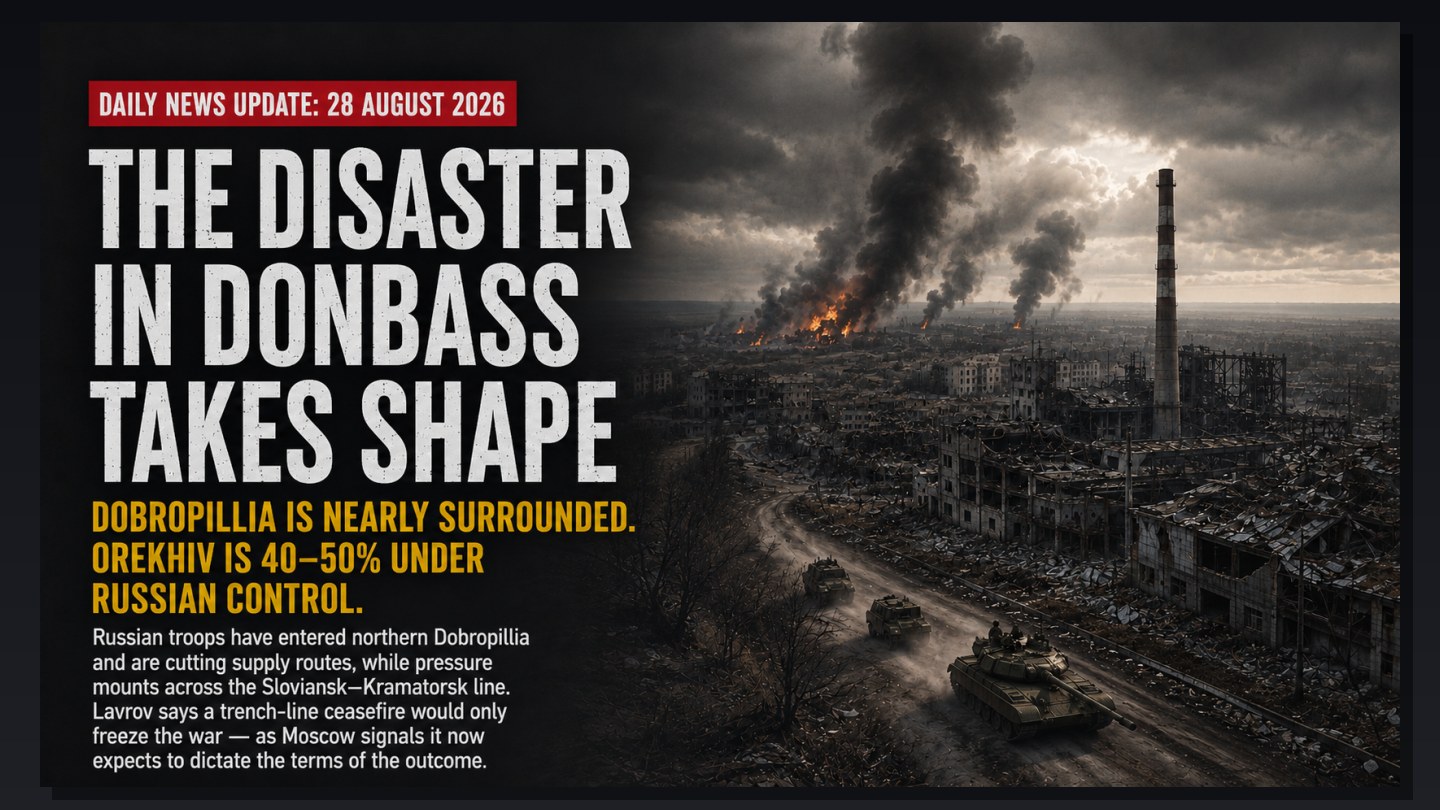
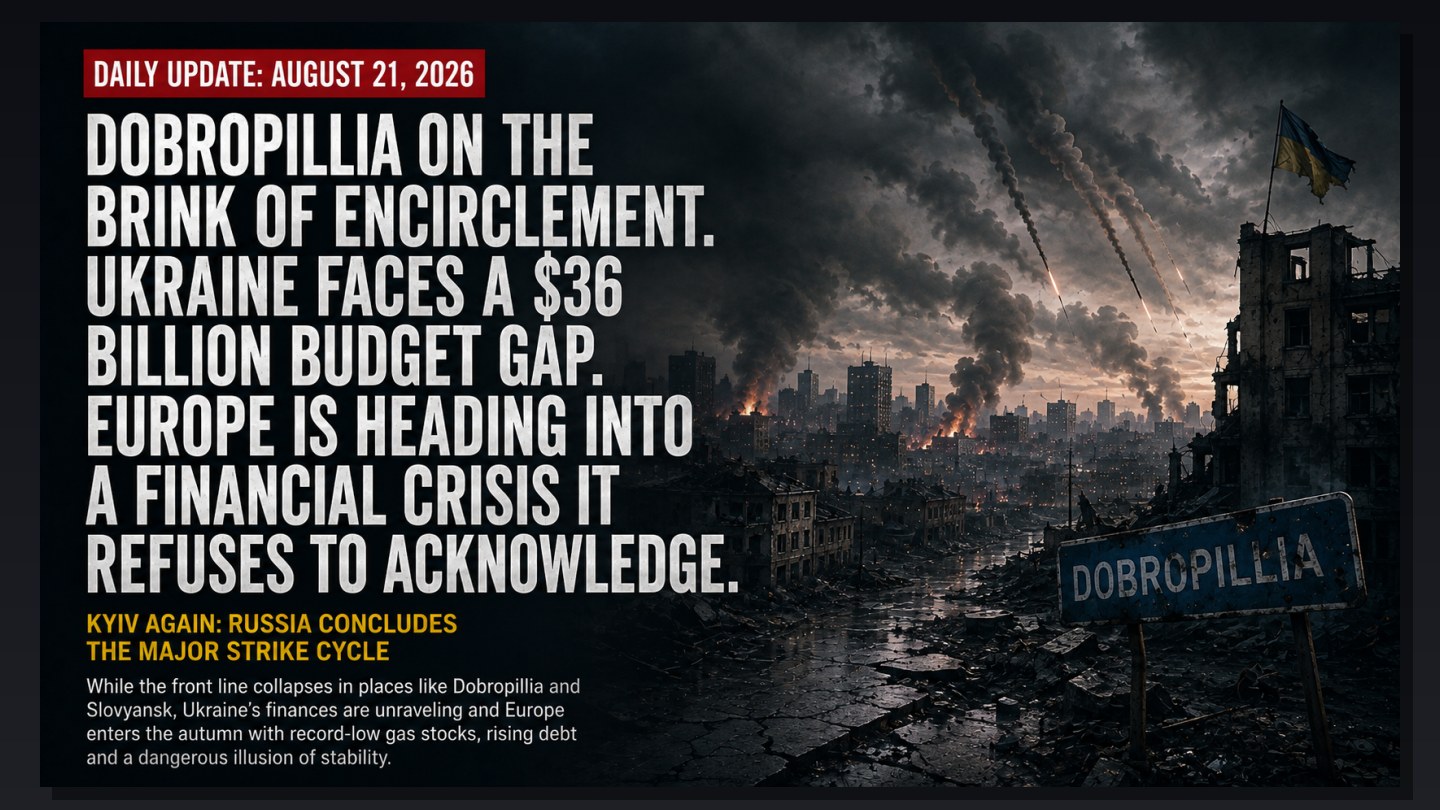
38 people killed in Myla. Kyiv bombed night after night without air defence. Dobropillia on the verge of collapse. More than half of Orikhiv under Russian control. Mykolaivka under pressure. Train delays into and out of Kyiv approaching 15 hours. Russia is the world leader in drones and is driving the drone revolution forward. Starlink is being jammed along the front line. Rassvet is expanding. And according to VIPS, Trump is receiving a false picture of the war.
There is one sentence that sums up the situation more clearly than any other, taken from Ukrainian Prime Minister Koretskyi after the Myla catastrophe:
“The terrible tragedy in Vyshneve did not become a lesson.”
It could just as easily serve as the epitaph for four and a half years of Western Ukraine policy:
What went wrong was never learned from.















Se og hør mer
Videoer, klipp og innslag knyttet til temaet.