The Zaporozhye bridge: the campaign expands
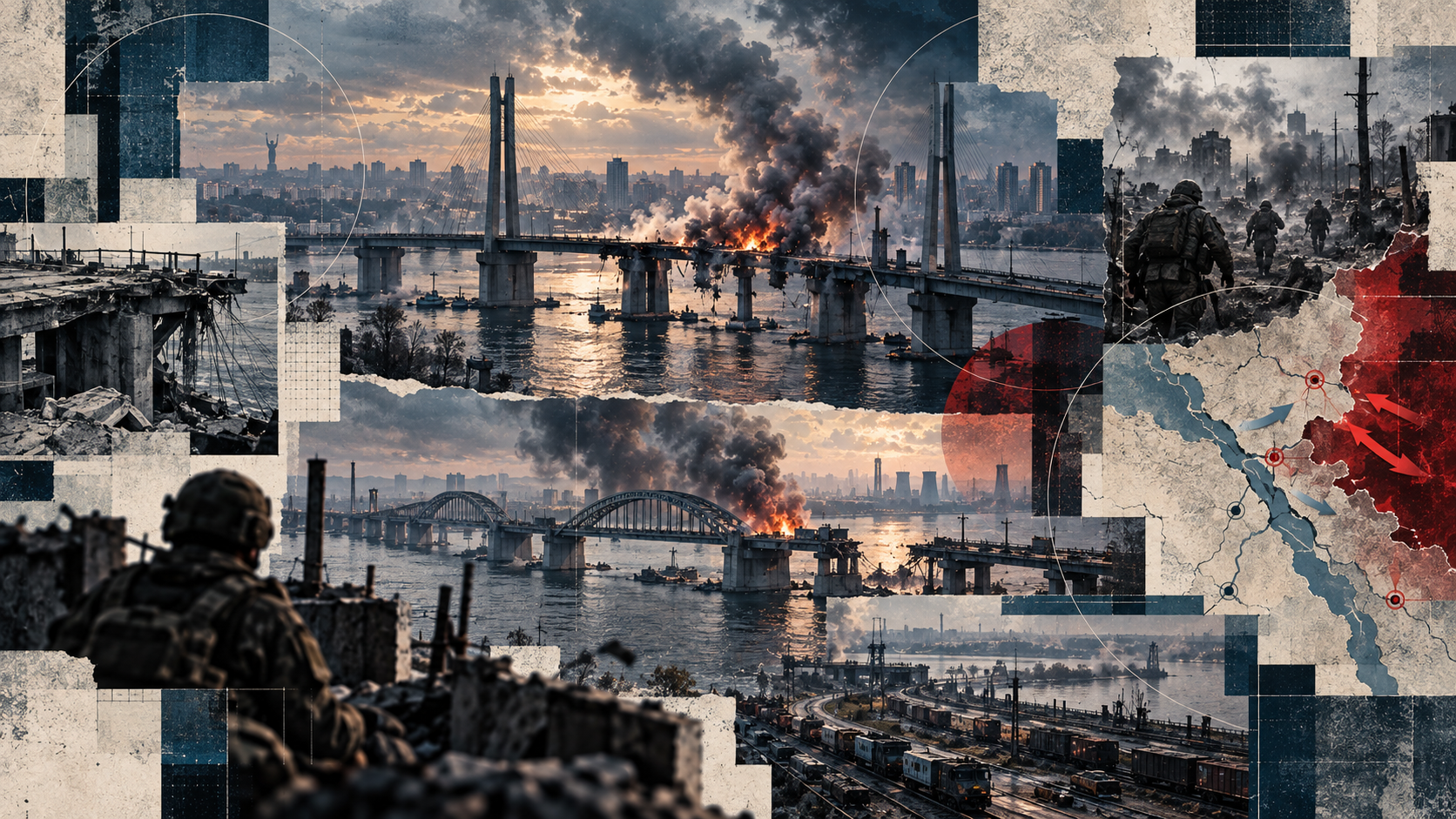
During the night to Tuesday, Russia struck one of the Dnieper bridges in the city of Zaporozhye, halting traffic and injuring five people, including two Red Cross staff. Since the beginning of October, Russia has repeatedly struck Kiev’s North and South bridges – none of the city’s nine bridges had been attacked before this month. It is now clear that this is no longer just a campaign against the capital. It is a campaign against the Dnieper crossings across Ukraine.
The city of Zaporozhye, together with neighbouring Dnepr, is probably the country’s most important industrial centre south and east of the Dnieper – a legacy of the Soviet era, when the city produced aircraft engines, ship turbines and the Soviet people’s car, the ZAZ. The Ukrainian dissident magazine Strana has previously warned that losing precisely these two cities would be a far greater blow to Ukraine than losing Kharkov – because it would sever the very lifeline between eastern and western Ukraine, while depriving the country of two of its largest logistical and industrial bases. A sign of how seriously the Ukrainian command itself takes the situation: the headquarters of Ukraine’s 7th Corps, which had been moved to Volyn to watch the border with Belarus, has now been relocated to Zaporozhye to take over the city’s defence – while the troops the corps previously commanded remain along the northern border.
Why the bridges are not being brought down – yet
The same Geran-4 drones with cable-cutting warheads that were developed to hit bridge structures are being used elsewhere to punch holes directly into the roadway – damage that can be repaired in days, but which in the meantime renders the bridge unusable for heavy military equipment. It is probably no coincidence that Russia is, for now, avoiding its most powerful weapons against these targets. A source with technical insight has previously described how a Kinzhal hypersonic missile, launched from a MiG-31 and guided precisely to the right point on a bridge, would cause catastrophic damage – both from the warhead itself and from the enormous kinetic energy of an object striking in a near-vertical dive at hypersonic speed. Russia has not used the Kinzhal against Ukraine for many months now, which may suggest that the system is either being upgraded or stockpiled for a later, more decisive moment – together with the Oreshnik and the new Iskander missile with an 800-kilometre range, which has not been deployed yet either. When they come, the war will probably reach a new level.
According to one source, there are also Soviet-built tunnels under the Dnieper at Zaporozhye and the city of Dnepr – shallow enough, according to the same source, to be hit with existing Russian weapons, and in practice easier to destroy than the bridges they are meant to replace as a fallback. The information about the tunnels cannot yet be independently verified.
The consequence if the bridges are actually closed for good
Should Russia at some point decide to put all the Dnieper crossings permanently out of action, it will not merely be a logistical nightmare for the Ukrainian army in the east, as Western media like to put it. It will be the end of the supply line. An army needs a continuous flow of food, ammunition, fuel and medical supplies. If all of this is stopped while it has to cross the Dnieper to reach eastern Ukraine, the Ukrainian army there will, by this assessment, be stranded on the wrong side of the river – and will eventually be wiped out.
Liman: the most detailed, most disturbing picture so far
On Monday, a Russian source gave an unusually detailed, if unverifiable, description of the fighting west of Liman: Ukrainian forces are infiltrating some villages, while Russian counterattacks hit supply lines and defensive positions elsewhere. The report speaks of heavy losses in a Ukrainian motorised brigade and describes a picture that resembles a meat grinder more than a successful offensive. This is consistent with what the well-known war correspondent Marat Khairullin said a week ago: that “Operation Vivaldi” is largely an invented narrative, and that the town of Liman itself remains firmly under Russian control, while scattered Ukrainian forces are holding out in the wooded areas west of it. It is telling that Azov leader Andriy Biletsky himself has not issued any new victory announcements in the past week – the silence suggests there is nothing to report. In about two weeks the rasputitsa, the autumn mud season, begins, which will probably make the offensive far harder to sustain whatever the outcome.
Orekhov and Dobropolye: silence as a warning
There has been strikingly little information from Orekhov in recent days – a pattern that has often meant that a battle is nearing its end. Russian forces are now pushing towards the village of Omelnik north-east of the town; if it falls, the cauldron will be completely sealed. In Dobropolye, the Russian Ministry of Defence continues to confirm advances in the central and northern parts of the town, in a pattern strongly reminiscent of the reports from Pokrovsk and Konstantinovka last autumn: Russia now appears deliberately to want to destroy the trapped garrison, not merely take the town – which prolongs the fighting, but also makes it far more costly for the Ukrainians.
The Moscow attack: costly, but with limited strategic effect
During the night to Tuesday, Ukraine sent nearly 900 drones against Russia, of which more than 700, according to Russian figures, were aimed at Moscow and the Moscow region. At least one drone hit the Volodarsk oil depot – the largest in the Moscow region and a supply source for several of the capital’s airports – for the first time in the history of the war. Two people were killed and at least seven injured. Beyond the depot, no extensive damage to important targets in Moscow itself has been reported.
Assuming an estimate of 50,000–60,000 dollars per long-range drone, an attack of this size represents an expenditure of tens of millions of dollars – a cost which, set against the result, underlines a point that has recurred for several weeks now: Russia’s air campaign against Ukraine appears to cost less per strike and hit harder than Ukraine’s campaign against Russia.
Europe: crisis on several fronts at once
In France, yields on government bonds are rising in parallel with renewed student protests and a broader wave of unrest, while French commentators on state television are still discussing plans to retake Crimea and Donbass for Ukraine. In Germany, following its election victory in Saxony-Anhalt, the AfD has now had its own candidate elected president of the state parliament – with four more votes than the AfD and BSW together could muster, a sign that representatives of other parties secretly voted in favour. Prime Minister Pedro Sánchez in Spain has called a snap election. And in Germany, young people have demonstrated against plans for conscription. None of these crises appears to change Europe’s course on Ukraine in the slightest.
None of these crises appears to change Europe’s course on Ukraine in the slightest. That is perhaps the most remarkable thing about the situation now. While Russia expands its air campaign, attacks the Dnieper bridges and continues to advance on several parts of the front, European leaders are still discussing the war in roughly the same terms as one or two years ago: more support, more weapons, more pressure on Russia and a continued belief that Ukraine can eventually turn things around.
At the same time, the price of this policy is becoming ever harder to separate from Europe’s own problems. France faces rising interest rates and new unrest in the streets. Germany has an AfD that is not only growing at the ballot box, but is now also beginning to break through the parliamentary isolation the party has long been kept in. Sánchez has been pushed into a snap election in Spain, while young Germans demonstrate against conscription and an ever larger share of Europe’s resources is tied up in rearmament and Ukraine.
Yet the rhetoric continues almost unchanged. On French television, there is still discussion of how Ukraine can retake Crimea and Donbass, and from Berlin come the same warnings about Russia as before. It is as if Europe’s political leadership has tied so much prestige, money and political capital to the outcome in Ukraine that there is no longer any easy way back.
That is why this autumn may prove far more decisive than any individual battle or drone attack would suggest. For if developments at the front continue while Russia systematically weakens the infrastructure that keeps the Ukrainian war effort going, Europe’s leaders will sooner or later be confronted with a question they have so far managed to put off: how long can one continue the same policy when the premises it was built on no longer exist?
For now, the answer to every problem is the same as always:
Send more money to Ukraine.