Ukraine stops reporting – because the figures are too embarrassing
Ukraine’s air defence has stopped publishing data on how many Russian missiles are fired and shot down. Bloomberg, which revealed the change, reports that the Ukrainian Air Force’s report for the night of 11 August stated that 98 of 120 Russian drones were shot down – but omitted the number of missiles fired or intercepted. A source at the Ukrainian Ministry of Defence confirmed that the format has changed and called it a “security measure”.
The real reason is not hard to understand. In July Ukraine shot down only 15 percent of Russian ballistic missiles after stocks of PAC-3 MSE interceptors ran out on 1 July. During the night of 5 August, not a single one of 28 Russian ballistic missiles was stopped. Continuing to publish such figures would make it impossible to sustain the narrative that Ukrainian air defence works. It is easier to stop reporting. Kyiv Independent confirms that the change came in the days after the 5 August attack, in which no ballistic missile was intercepted.
Among the confirmed targets of the night of 11 August were the Nova Poshta terminal – an automated sorting centre for drone components and robotic vehicles – and the Sun Park storage facility, where according to the Russian Defence Ministry up to 15,000 drones with associated thermal cameras and ground stations were stored. Russia is now retaliating for Ukrainian attacks on Wildberries warehouses with similar attacks on Ukrainian warehouse and logistics facilities in Kyiv. The consequence is the beginning of empty shelves in Kyiv’s grocery stores, as food warehouses have been hit.
Russia increases missile production – Ukrainian intelligence revises its estimates
Ukraine’s military intelligence has sharply revised its estimates of Russian Iskander-M production upwards: from the earlier estimate of 70 per month to 120 per month – with the production rate still growing. It is an admission that the Russian defence industry has performed far better than Western analysts assumed. And it is that admission which makes the Financial Times’ recommendation this week that the West “give everything it has left” to Ukraine a meaningless exercise: there is no static Russian missile stockpile to deplete. There is a growing production machine that is currently producing faster than Ukraine and the West can field countermeasures.
Ukraine intercepted 29 of 195 Russian ballistic missiles in July – the remaining 126 hit their targets. Over 8,300 glide bombs were dropped on Ukrainian positions and infrastructure in July alone, the highest monthly figure in the history of the war. That is not a peak. It is the new normal.
The Financial Times’ impossible solution
This week the Financial Times published an editorial titled “Ukraine needs more help in the air war” – and contradicted itself on three points. First, the paper insists that the situation on the front lines is “deadlocked”, which is not true: Kostiantynivka has fallen, Lyman has fallen, Orikhiv is encircled and Dobropillia is being stormed. Second, the paper exaggerates the effect of the drone offensive and claims Russia is “under pressure” – flatly contrary to the statistics. Third, the paper proposes giving Ukraine access to advanced Starlink capability to attack Russian mobile missile launchers inside Russian territory.
This last point is the most dangerous. Russian mobile missile launchers do not only carry Iskander-M and Zircon. They also carry RS-24 Yars intercontinental ballistic missiles – a mainstay of Russia’s strategic nuclear arsenal. They carry the Oreshnik system. And the Zircon itself probably has a nuclear capability. Giving Ukraine the capability to track and attack mobile Russian missile launchers is – without exaggeration – giving it the ability to attack Russian nuclear infrastructure. That is an escalation of an entirely different character from anything done so far in the war. That the Financial Times recommends this without discussing the nuclear implications is not just analytical sloppiness. It is irresponsible.
The F-16s are being worn out
Ukraine’s fleet of around 39 F-16 fighters is being worn out. They are not used in any offensive role – Russian Su-35s, Su-30s and Su-57s are too superior for Ukraine to challenge them with F-16s. Instead the F-16s are used almost exclusively to try to shoot down Russian Geran drones – night after night, in huge numbers. Each F-16 uses air-to-air missiles against drones that cost a fraction of the missile’s value. The result is a rising maintenance burden and rapid wear of airframes. The F-16s delivered to Ukraine with promises that they would turn the war are being used up in an anti-drone role they were not designed for.
Zaluzhnyi recently commented on this pattern: HIMARS was a turning point in 2022, and it did contribute to Ukrainian success in the Kherson region. But the Russians adapted within weeks: they jammed the system, dispersed their logistics and made it effectively ineffective. It is the same pattern for all Western weapons systems delivered to Ukraine. Russia is the world’s most experienced military power at adapting to new threats – not for ideological reasons, but because it has had four years to practise.
Kramatorsk is being encircled from the south
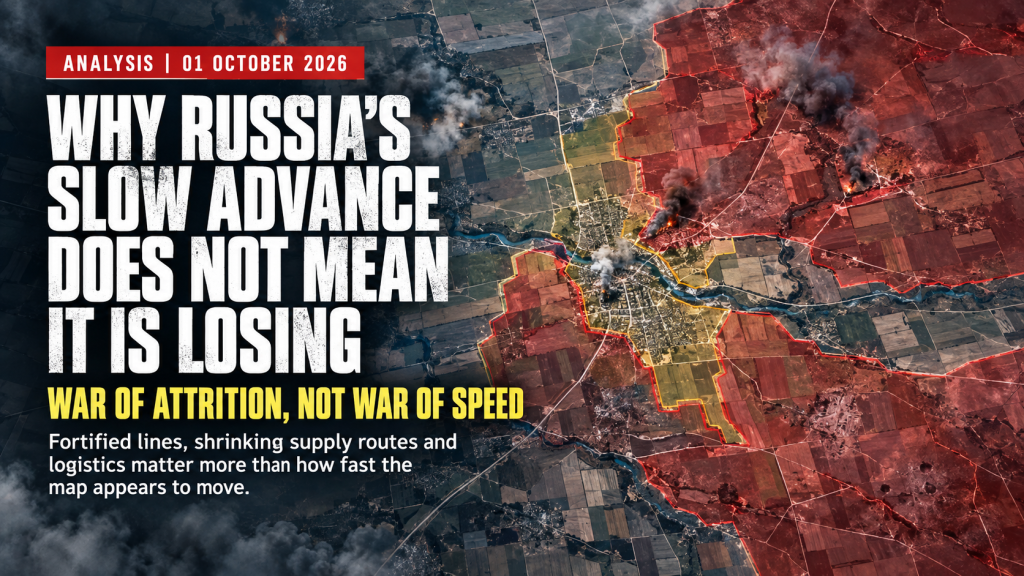
On Monday the Russian network of military analysis channels reported Russian penetration into Oleksiivka – the satellite town immediately south of Duiivka and north of Kramatorsk. The military blogger and analyst Marat Khairullin gave his usual sober assessment: Russian forces have now positioned themselves in a “spearhead” pointing directly at Kramatorsk from the south-east. Combined with the pressure on Dobropillia from the south and west, and the fall of Lyman in the east, an encirclement dynamic is taking shape around the entire Sloviansk–Kramatorsk conurbation. The Sloviansk thermal power station is under sustained Russian pressure from the north.
The Ukrainian military commentator Stanislav Kapivnik stresses something that is often overlooked: from the end of September, the rain in Donbas begins to soften the ground. In the rasputitsa period – the muddy autumn thaw – vehicles cannot use open terrain. They are confined to the roads. And the roads into Sloviansk and Kramatorsk from the north and west are under constant Russian drone interdiction. If Ukrainian supply lines to these cities are cut by rasputitsa and Russian drone warfare combined, the soldiers in Sloviansk and Kramatorsk will be left without supplies – and without the possibility of retreating over marsh and soft ground in the dark with Russian drones circling above them.
The Bryansk build-up: a mechanised offensive against Kyiv
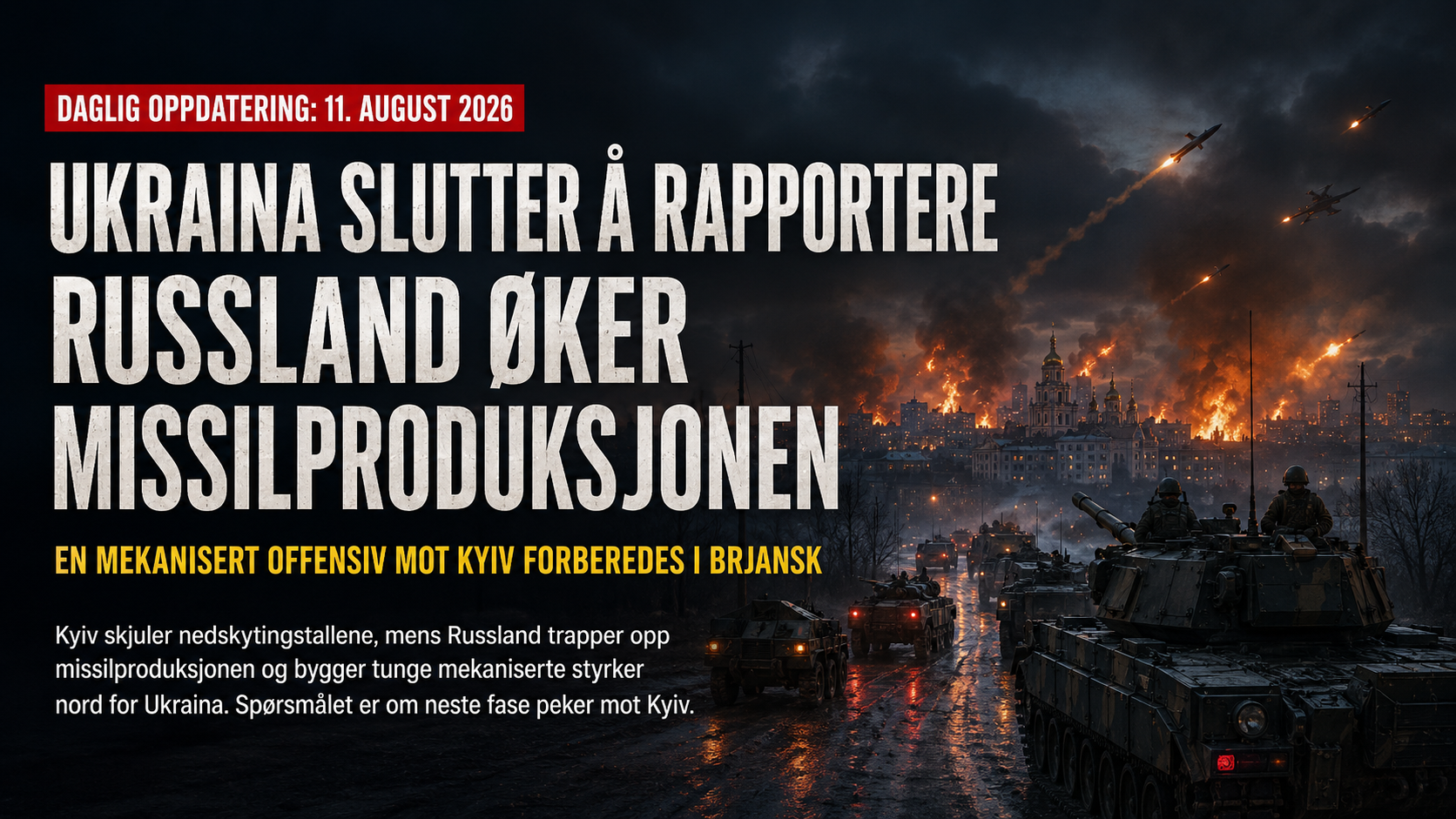
A well-informed source who has been in contact with this editorial team describes what is being assembled in the Bryansk region on the border with Chernihiv: heavy mechanised forces with tanks, armoured vehicles and self-propelled artillery – far heavier than what the Russians have used in Donbas and Zaporizhzhia. Drones are deeply integrated into the structure, not as support assets, but as long-range artillery and ground-attack aircraft operating ahead of the units. The infantry component is heavier than in the pre-2022 Russian military, but the forces are more mobile than what we have seen in the trench war.
These forces do not appear to be built up to take Chernihiv city – that would not justify the weight of equipment reported. The logical objective for such a force, with the open steppe of the Chernihiv region between the border and Kyiv, is Kyiv. It is an assessment shared by Ukrainian military intelligence, which is now openly warning of the danger.
Russia probably wants to wait until Donbas is secured – which would remove the need to hold reserves there – before setting these forces in motion. But the time margin is not necessarily large.
The West has no plan
“The West’s investment in Ukraine’s drone war has failed. And although I suspect they have a fairly good idea of what Zelensky is trying to do with his drone attacks on Valdai and Gelendzhik, they have no realistic plan beyond that”, a Western commentator observed this week. It is a precise summary. Witkoff and Kushner are not travelling to Kyiv. They are not travelling to Moscow. The Vienna channels are secret and without a mandate. And the only diplomatic instrument with credibility in Moscow – direct dialogue at the highest level – is not being used.
If nothing happens and Donbas falls, some media will demand Western ground forces in Ukraine and no-fly zones over Ukrainian territory. That is the logical consequence of the rhetorical overreach that has marked four and a half years of Ukrainian war coverage: things can always be escalated a little more. But “a little more” is in this case the road to direct war with Russia – with a nuclear power that is now furious about four years of Western help to Ukraine, and whose general staff already says this is a real war, not a limited operation.
That is what awaits on the other side of yet another escalation.