A massive strike expected within 48 hours
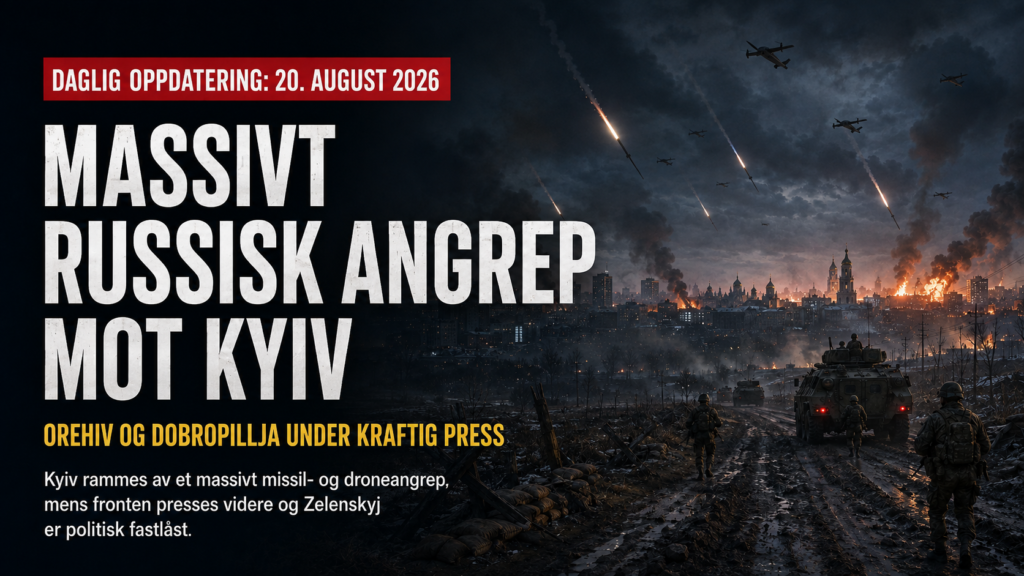
According to reports, US intelligence has informed Ukraine that Russia is preparing a new, large combined strike – possibly against Kiev itself – within the next 48 hours. Large numbers of Iskander-M ballistic missiles are reported to have been moved through western Russia, strategic bombers loaded with cruise missiles, and Russian reconnaissance drones are flying over central Ukraine and Kiev to map the damage after the strikes on the bridges.
The status of the bridges that were hit has shifted over the weekend, but traffic across the Dnieper remains heavily disrupted after repeated Russian strikes. At the same time, the Ukrainian authorities have installed twelve remote-controlled, AI-assisted gun systems around Kiev to counter jet-powered drones. On Monday, the Ukrainian Air Force claimed that such systems have already shot down both jet-powered drones and Geran-5s.
The technology behind the bridge strikes: drones approaching cruise missiles
A Ukrainian intelligence report confirms that newer Geran-4s and Geran-5s are equipped with the autonomous navigation system “Susanin”, which allows them to fly to the target without continuous contact with a ground operator. The system combines terrain-referenced navigation with optoelectronic target recognition, and some variants are also said to have received more powerful Russian-made engines.
This fits with reports of Geran-5 drones reaching around 800 kilometres per hour at high altitude. A drone with a powerful engine, long range and autonomous guidance is in practice beginning to approach the category of a small, subsonic cruise missile.
It also better explains why the bridges over the Dnieper have only now become systematic targets. Throughout the war, Russia has claimed that it tries to limit civilian casualties, and precision strikes against specific structural points of a bridge in the middle of a city of millions place entirely different demands than an ordinary strike on a large industrial site.
The strikes so far appear to be aimed at making the bridges unsafe for heavy traffic, not necessarily at bringing them down. Complete destruction would probably require repeated hits with several types of weapons – Iskander, Kalibr, Zircon and drones in combination. And should Russia one day take Kiev, it is obviously easier to repair a standing bridge than to build a new one.
Ukraine: 51 per cent of Russian refining capacity knocked out
The figure cannot be independently verified and should be treated accordingly. Russian refinery output has fallen considerably after Ukrainian strikes, but available production figures do not document that more than half of total capacity is actually out of operation.
At the same time, Zelensky announced a further escalation of attacks on Russian refineries – in response to Russia’s increasingly extensive air campaign against Kiev.
Merz: empty-handed, again
During Friedrich Merz’s visit, Zelensky once again raised the question of Taurus cruise missiles – the same weapon Ukraine has been requesting since 2024. Merz promised Taurus as opposition leader, but as chancellor he has still not approved delivery.
What Merz actually brought was one billion euros in new military support and a further 350 million for the energy system. The package includes, among other things, drones, long-range weapons, satellite capacity and financing for Ukrainian interceptor drones.
But Germany is not transferring around eleven billion euros a month to Ukraine. The German government has set aside around 11.5 billion euros in military support for the whole of 2026.
Should Germany nevertheless deliver Taurus, the practical effect is not necessarily as dramatic as the political debate suggests either. Taurus is a subsonic cruise missile with a publicly stated range of around 500 kilometres. That makes Moscow hard to reach from safe launch areas far to the west of Ukraine, while aircraft moving far to the east to reduce the distance would at the same time be operating much closer to Russian air defences and fighter jets.
Operation Vivaldi: Biletsky drains the defence of Slavyansk and Kramatorsk
On Monday, the head of the Russian-backed regional administration in Donetsk, Denis Pushilin, gave the most detailed Russian update in weeks on the fighting at Liman. According to him, the heaviest fighting is now taking place there, with Ukrainian reinforcements sent in to try to show a concrete result after earlier reports of progress.
This also means that Operation Vivaldi does not consist only of small reconnaissance and sabotage groups, as some Russian sources previously claimed. A real Ukrainian offensive is under way. But it appears to have stalled against fortified Russian positions.
An analysis by the Russian newspaper Readovka goes further: Andriy Biletsky’s attempt to force a visible victory at Liman is said to be draining forces and equipment originally earmarked for the defence of Slavyansk and Kramatorsk.
At the same time, Biletsky has an obvious problem. Having presented Operation Vivaldi as a major Ukrainian counter-offensive, it is politically difficult to end it without a result that can be shown off.
If Readovka’s information about the transfers of forces is correct, the paradox is therefore striking: the longer the offensive at Liman continues without a breakthrough, the more the forces that are later to defend the far more important cities of Slavyansk and Kramatorsk are weakened.
An offensive meant to demonstrate Ukrainian initiative may thus end up making the main Russian offensive in Donbass easier.
Dobropolye: the encirclement is being restored
Pushilin’s update on Dobropolye is just as interesting. He said that Russian forces are advancing westwards to “complete the encirclement” of the Ukrainian formations – a phrasing that indirectly supports reports that Ukraine recently managed to punch an opening through the Russian ring.
At the same time, the Russian Ministry of Defence reported further progress in the southern and central parts of the town, with 51 buildings taken in the past 24 hours. This fits a picture in which the Ukrainian breakthrough is being pushed back and the encirclement is gradually being re-established.
How much of the town Russia actually controls is less clear. Estimates of 60–70 per cent come from Russian sources and cannot be independently confirmed.
Zaporozhye: preparing for the next phase
On Monday, the Russian Ministry of Defence reported that the East group of forces had taken the village of Samoylovka in the Zaporozhye region. The village lies north-east of Orekhov and is less connected to the battle for the town itself than to what may come afterwards.
The ministry itself described the capture as a bridgehead for a further advance towards Ternovka.
This fits into an increasingly clear pattern: while the battle for Orekhov continues, Russian forces are already positioning themselves for the next phase further west – towards Zaporozhye itself.
Conclusion
Russia has made one thing clear over the weekend: the strikes will continue and intensify, and no ceasefire is under consideration on the current terms.
Now come warnings that a far larger combined strike may be imminent.
Whether it actually comes within the next 48 hours, we do not yet know. But Russian reconnaissance drones are mapping Kiev, the bridges are being struck again and again, new weapon systems are being deployed, and on the ground the pressure continues from Liman to Zaporozhye.
The coming days may therefore show whether the weekend’s strikes were merely a continuation of the air campaign – or the preparation for something far bigger.