
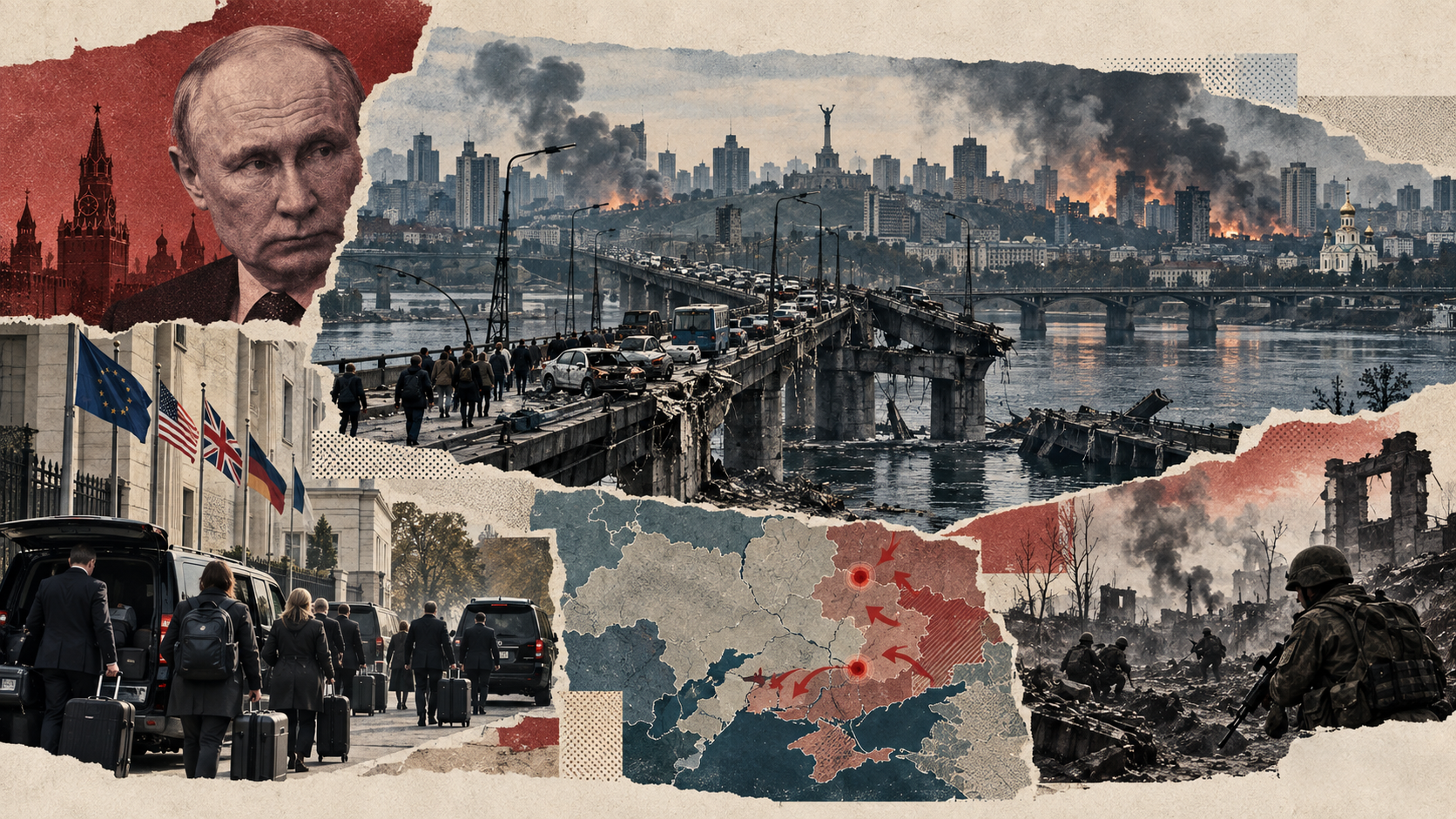
The North Bridge hit – exactly as expected
On Saturday, Russian forces struck Kiev’s North Bridge over the Dnieper, damaging the roadway and the trolleybus cables and halting traffic towards the right bank. It came after several strikes on the South Bridge in the preceding days, which had already caused major traffic disruption in a city where more than a third of its roughly three million residents live on the left bank, while much of the workforce is employed on the other side of the river.
The images that circulated were telling: people abandoned their cars and crossed the bridges on foot to keep moving while traffic stood still.
Russia had avoided systematic strikes on these bridges throughout the war, even though they are the very lifeline that binds the eastern and western banks of the city together. That restraint is now over.
The South Bridge has been hit repeatedly, including in its load-bearing structure. After the first strike, Ukrainian authorities reported that no critical structural damage had been found, but further strikes followed and traffic was once again restricted.
It has not yet been documented that specialised Geran warheads have actually cut the suspension cables on the South Bridge. But Russia has already demonstrated a new type of warhead designed precisely to cut through high-voltage pylons and steel structures, and the bridges have now clearly been added to the target list.
The North Bridge was initially closed after Saturday’s strike. Later the same day, city authorities said traffic was again flowing normally across the North Bridge, while special restrictions still applied to some other crossings during air-raid alerts.
What matters, therefore, is not whether two bridges are physically closed right now. It is that Russia has shown it can hit them again and again.
If the strikes continue against the most important crossings, the city could in practice be split in two for ever-longer periods – without a single bridge having to collapse completely.
Guardian: “The enemy is tearing our city apart”
“We can no longer pretend we are living in peacetime,” Klitschko told the Guardian after several days of strikes on the city. The mayor fears Russia will move on to the remaining bridges and thereby paralyse movement across the Dnieper.
The article, with its telling headline “The enemy is tearing our city apart”, ends with a quote from an anonymous Western diplomat: Russia’s plan is to freeze Kiev out and bomb the city back to the Stone Age.
Western diplomats say publicly that they intend to stay – leaving would hand Moscow a propaganda victory and signal that Ukraine is being abandoned.
Privately, two senior diplomats say contingency plans are now being drawn up to move the embassies to Lvov or eastern Poland.
Russia says it plainly
“The Russian Armed Forces will continue to carry out massive retaliatory strikes. Responsibility for any negative consequences rests entirely with those who ignore this warning.”
This is not a new threat. It is a repetition of something Russia has said several times since May – and which it is now actually following up with a far more extensive air campaign against Kiev.
On 25 May came a new and far more sweeping warning of systematic strikes against the defence industry and so-called “decision-making centres” in Kiev. At the same time, Russia again urged diplomats and other foreigners to leave the city.
Those who dismissed this as pure bluff were wrong about at least one thing: the air campaign came.
Why this ties into the front – not separate from it
There is a widespread view in Western media that the strikes on Kiev and the fighting on the ground are two separate stories – that Russia is bombing the capital because the offensive in the east has stalled.
That is a misunderstanding.
Kiev is the hinge that binds western and eastern Ukraine together. If the railway, the bridges, the energy system and the internet fail at the same time, the army loses the very backbone it needs for reinforcements, ammunition, fuel and food.
That is precisely why air offensives are waged in the first place.
The front: Dobropolye being cleared, Orekhov under ever-heavier pressure
The ministry also reported around 20 Ukrainian soldiers “neutralised”. The low figure may suggest that the garrison was already relatively thin before the Russian breakthrough, and that part of the fighting now concerns securing areas Russian forces have already penetrated.
That is nevertheless an inference, not something the Russian Defence Ministry’s figures alone can prove.
In the Zaporozhye region, Russian forces are closing in on Omelnik. Russian front reports on 3 October placed Russian forces on the Orekhov–Omelnik road and on the outskirts of Omelnik itself, while heavy fighting continued in the northern part of Orekhov and near Preobrazhenka.
Readovka goes further and describes the operation as the final phase in reducing the Orekhov fortified area. The outlet itself writes, however, that Ukrainian forces still hold northern Orekhov, Preobrazhenka and Omelnik.
It is therefore too early to conclude that the cauldron is fully closed or that the battle has already been decided.
Further south, on the east bank of the Dnieper, Russian forces have meanwhile regained some of the ground they previously lost. If the advance continues northwards through the winter, the direction will eventually lead towards Zaporozhye itself.
There is less and less information about Andriy Biletsky’s much-discussed offensive near Liman – a pattern of silence that is telling in itself.
Russian sources claim that Liman remains under Russian control and describe much of the Ukrainian activity further north as minor raids rather than a coherent offensive. Ukraine, for its part, continues to claim progress in Operation Vivaldi.
With the rainy season just around the corner, the window for larger operations over open terrain is shrinking in any case.
The quiet offensive in Kharkov
Russian military analyst Sergei Poletaev has pointed to something that deserves more attention than it gets: the Russian advance in the east of the Kharkov region has been unusually little reported, overshadowed by the more dramatic events in Donbass and in the skies over Kiev.
If Velikiy Burluk falls and Russian forces manage to tie this axis more closely to the West group of forces near Kupyansk, it opens the possibility of further pressure southwards towards Izyum.
That would have direct consequences for the Ukrainian positions north of Slavyansk.
It is, in other words, a front that could prove decisive for the outcome in Donbass itself, even though it is barely mentioned in Western media.
What if Kiev is actually emptied
Imagine the scenario a few weeks or months ahead: the embassies move to Lvov or across the border to Poland, the Ukrainian civilian administration follows, and Zelensky himself is left behind in a city that in practice no longer functions as a capital.
It would no longer be an impression that Kiev has been abandoned – it would be a fact.
The Ukrainian government’s ability to maintain control over the whole country would weaken, and a sense that the war is being lost could spread. Some would flee westwards. Others would try to adapt to whatever situation arises where they live.
That some might also choose to travel east to Russia is possible, but at this point it is speculation.
For the West, this raises an uncomfortable question: if it is no longer possible to maintain direct personal contact with Zelensky and the Ukrainian leadership because transport links are badly weakened – or because the leadership itself has moved west – will European taxpayers and governments still be willing to send ever-larger sums eastwards if the military situation is deteriorating at the same time?
Ukraine has already received an EU loan of 90 billion euros for 2026 and 2027.
And the reaction in Brussels is no longer unreservedly positive.
“It feels like we are watering the desert,” an anonymous European diplomat told Le Monde.
It recalls John F. Kennedy’s old image of aid to South Vietnam: a glass of water that brings relief for a short while, before the thirst returns.
The difference is that in Ukraine’s case, each glass seems to have to be bigger than the last.



Se og hør mer
Videoer, klipp og innslag knyttet til temaet.