
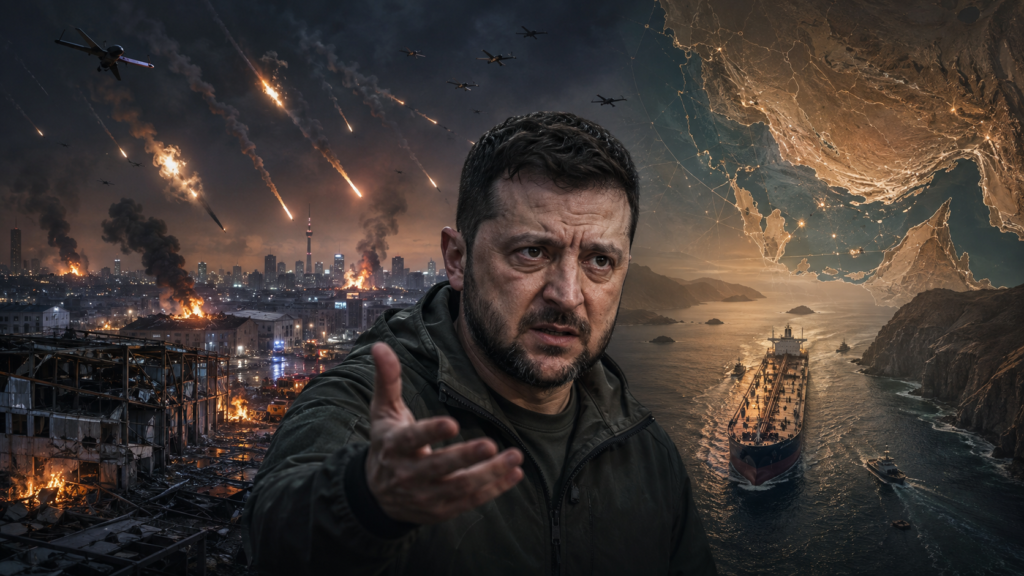
Zelensky asks for peace at sea – Russia responds with contempt
On Friday, Russia categorically rejected the Ukrainian proposal, conveyed through Turkey, for a mutual halt to attacks on merchant ships in the Black Sea. Foreign Ministry spokeswoman Maria Zakharova described the proposal as a “half-measure” that would only give Ukraine breathing space to rearm. Zakharova also stated that Russia never received any formal Turkish proposal through official channels – something Ankara directly refuted.
Lavrov followed up in an interview with Russian state TV, also categorically rejecting any freezing of the fighting along the existing front lines: “That would mean letting the feats of our forefathers and great-grandparents – the victory over Nazism in the Second World War – go to waste. This option is not on the table.” He added that Russia will use “far harsher methods to destroy everything that enables the West to run Kyiv’s war machine”.
Lavrov also sharply criticised Turkey and the US for ignoring Ukrainian attacks on their own interests. “We were not the ones who started this. When Ukrainian drones attacked a Turkish dry-cargo ship, a tanker or a civilian vessel – when the same drones repeatedly attacked the infrastructure of the Caspian Pipeline Consortium and hit vessels directly linked to American companies such as Chevron and ExxonMobil – neither Turkey nor the US declared that Ukrainian acts of terror were unacceptable”, Lavrov said. He revealed that US Vice President JD Vance had passed a private message to Zelensky to stop the attacks on the Caspian Pipeline Consortium – and that Zelensky promised to stop the attacks but never followed through.
It is a shocking revelation that confirms two things at once: that the US and Ukraine coordinate their public narratives, and that Zelensky routinely ignores direct private warnings from his most important backer. Russia is aware of both. That is probably part of the reason Lavrov uses the term “terrorist regime” for Kyiv’s current government.
Britain admits: We cannot protect ships
On Friday the Daily Telegraph published an interview with retired Admiral Lord West, former head of the Royal Navy, in which he acknowledged that Britain does not have sufficient naval power to protect British merchant ships from Russian seizures. Lord West’s choice of words was undiplomatically direct: “Our navy has been cut and cut and cut, and we do not have enough ships to fulfil our role of protecting global shipping. It is extraordinary that successive governments have allowed our navy to be reduced in this way.”
According to the Daily Telegraph, Britain has only two patrol vessels deployed to the Indo-Pacific – where Russia has ordered its Pacific Fleet to inspect and detain Western merchant ships. That is two ships against a Pacific Fleet that was shown off in a full exercise when Putin inspected it from the deck of the cruiser Varyag just two days ago. That is not uneven. It is a fight that would not even begin.
The newspaper further reports that the British military is now desperately trying to establish contact with the Russian General Staff in Moscow and St Petersburg to understand what Russia actually intends – and that Russia consistently rejects the approaches. It is possible that Russia had already given Britain private warnings that the ship-seizure decision was coming, and that the Vienna meeting and other secret diplomatic attempts in recent weeks are partly a response to Russian private signals. If so, the British panic is well founded.
Dr Jack Watling in The Guardian: The grim message of the numbers
In a rare fit of editorial honesty, The Guardian on Friday published an analysis of Russia’s air superiority over Ukraine written by Dr Jack Watling of RUSI – Britain’s leading defence think tank. Watling acknowledges that Ukrainian air defence is now completely unable to protect Kyiv against Russian ballistic missiles: “Intercepts have gone from more than 70% to none. So that night after night, Russia strikes Ukraine’s infrastructure with impunity”.
Watling states that the US is now left with around 200 older PAC-2 interceptors – widely recognised as ineffective against ballistic missiles – and around 600 PAC-3 interceptors. By comparison, according to Ukraine’s own estimates, Russia produces 1,400 Iskander missiles a year. Firing two to three Patriot interceptors per incoming missile against a production rate of 1,400 a year is arithmetic that does not add up. And Watling’s own figures from the Middle East suggest that in practice up to 17 interceptors are needed to defeat one Iranian ballistic missile. If that is the norm, Ukrainian air defence is not only exhausted – it was never sized for this scenario at all.
“Ukraine will not receive enough Patriot missiles by winter to save its critical national infrastructure, regardless of whether some countries make the political gesture of releasing a few from their own stocks”, Watling concludes. He recommends that Kyiv now plan for a winter with severely disrupted power and that vital systems – water, sanitation, electricity and heating – be dispersed and fortified.
These are remarkable words from a man writing for The Guardian, not from an outlet the West has labelled “Russian propaganda”.
Duvivka and Oleksiivka: Encirclement begins
The front picture for 14 August is the darkest we have seen. The Ukrainian military blogger Mukhnoi Yugand – according to his editors an active soldier at the front – published a post on 11 August that Events in Ukraine has reproduced and translated: “I am afraid to write anything to you today. I’m sorry, but this is hell. The situation is so difficult and tense that I don’t even want to try to find the right words or pretend that everything is under control. Too many problems have piled up at once, and now we are seeing the consequences. I don’t want to alarm people unnecessarily, but nor do I want to hide the obvious. The situation is serious. Very serious.”
Yugand is sceptical of Zelensky’s triumphant announcement of Ukrainian progress in northern Zaporizhzhia – he notes that the villages supposedly taken are tiny hamlets and that some of them have not been taken at all, but are “contested” – that is, still under Russian control. His description of the front lines around Duvivka is consistent with what Russian military bloggers and independent Western analysts say: Russian forces now control the territory east of Duvivka and Oleksiivka, and are approaching from the west via villages such as Toretske, Petrivka and Novolypivka – so that Duvivka and Oleksiivka themselves will soon be surrounded on three sides.
Mukhnoi Yugand acknowledges, reluctantly and against the official Ukrainian line, that Kostiantynivka is lost. He describes the situation at the Sloviansk thermal power plant as critical. And he confirms the fighting for Mykolaivka – the village immediately west of Sloviansk, where Russian control would mean that Sloviansk is in practice encircled.
Russia’s GDP grows – Ukraine’s economy breaks down
In the midst of this military and diplomatic defeat came figures from Russia that tell the fundamental story of what the war is actually doing to the two countries’ respective ability to sustain it. Russia’s economy ministry reported that GDP grew by 1.3 per cent in the second quarter of 2026 – and that industrial and manufacturing growth is accelerating into the third quarter, despite a central bank rate that is above 10 per cent in real terms. Russia is getting bigger and richer, not smaller and poorer, as the war continues.
Ukraine, by contrast, according to a number of Ukrainian business organisations – metallurgy, agriculture, transport – is in an acute crisis in which exports of three-quarters of agricultural goods have stopped, grain has nowhere to be stored, farmers lack diesel for the harvest, and industrial production is collapsing. Western emergency financing through the IMF and the EU keeps the country afloat – but at the cost of debt that already exceeds 100 per cent of GDP and is growing weekly.
China further opens Europe’s financial system to the renminbi
At the same time, movements are taking place far from the battlefield that may prove more long-term than developments at the front. China’s central bank, the People’s Bank of China, has designated Deutsche Bank in Frankfurt as an official renminbi clearing bank. That makes Deutsche Bank the first non-Chinese bank in Europe permitted to clear and settle transactions directly in the Chinese currency.
This is a far more significant development than the technical wording suggests. Most Chinese clearing banks outside China have until now been local branches of the country’s four big state-owned banks. Now one of Europe’s largest banks gets a direct bridge into China’s financial infrastructure. For European companies, it means that trade, financing and payments with China can more easily be carried out directly in renminbi – without the same dependence on dollar-based payment flows.
The Financial Times places the decision within Beijing’s broader strategy to increase the renminbi’s international role. China is not only trying to sell more to the world, but to get an ever larger share of the world’s trade, credit and investment conducted in Chinese currency. That this infrastructure is now being built into Frankfurt itself – the heart of Europe’s financial system – is therefore another small but concrete sign that the global financial order is gradually becoming less one-sidedly dollar-based.
What has become clear
The former British diplomat Ian Proud, who runs the website The Peacemonger, quotes a Ukrainian war refugee and academic who describes what the war has actually become for ordinary Ukrainians: “The war is no longer about territory or victory. It has become a very profitable business for a narrow elite centred around Zelensky. Defence contracts, energy deals, Western aid – the money flows upwards while the bodies pile up. Corruption is not a side effect. It is the operating system.”
It is a harsh verdict. But it is not unreasonable given what can be observed: a country where men are dragged off the streets and declared fit for combat regardless of their health, where families receive a phone call and find a body outside the building, where the drone-production billions flow upwards while soldiers in the trenches drink urine because they cannot be rotated out. This is not what the West was told it was supporting. It is what it is actually doing.
Lavrov’s words on Thursday morning are the most precise summary of the Russian position as of 14 August 2026: “We will use far harsher methods to destroy everything that enables the West to run Kyiv’s war machine. We are already doing so – and they are already complaining.”


Se og hør mer
Videoer, klipp og innslag knyttet til temaet.