
Three Hours in St. Petersburg
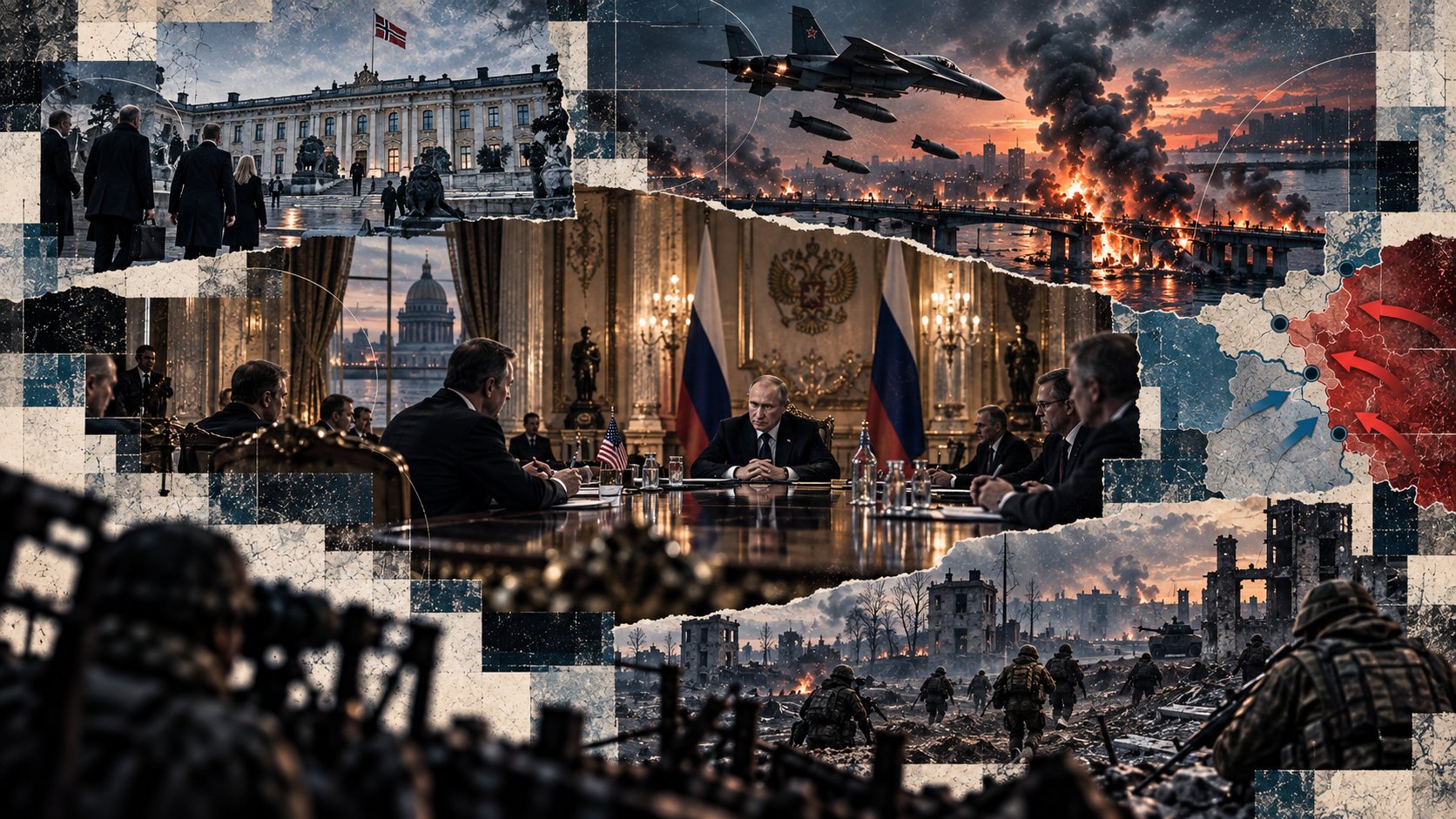
On Wednesday, Steve Witkoff met Putin at the Konstantin Palace in St. Petersburg, with Jared Kushner joining by video. The meeting lasted around three hours and came the day after Witkoff had met Zelensky, Støre and Stubb in Oslo. Putin’s foreign policy adviser Yuri Ushakov said afterwards that Putin is in principle ready to resume trilateral talks between Russia, the United States and Ukraine after 10 November. Ushakov described the subject as building a security system for Russia and Ukraine after the conflict is over. No ceasefire has been announced ahead of the talks. The new ideas from Ukraine and the EU presented by Witkoff contained little that was useful, according to Ushakov for resolving the crisis. That shows Moscow does not believe the proposals provide a sufficient basis for a breakthrough.
Witkoff himself speaks of “some momentum”, and a US official says both sides have agreed to the trilateral meeting. Moscow also did something small for Trump: Stephen Hubbard, a 74-year-old American convicted of having served as a mercenary in Ukraine, was released. Putin also showed interest in economic cooperation with the United States and in a meeting with China on Ukraine. Who initiated that summit remains unclear. The Wall Street Journal wrote that Putin proposed it, but another assessment is that the idea came from Trump, since Moscow would hardly have proposed such a meeting without first clearing it with Beijing, and China has its own issues to discuss with the United States.
Moscow’s line had been clear the day before. Lavrov said Russia would listen to what Witkoff and Kushner had to offer, but that there would be no political concessions. He added that agreements with the United States can easily be reversed by the next president, and that “another president will come, who knows how he will behave”. Trade and economics are another matter. Russia is open to agreements there, but without paying a political price.
The Oslo Plan
What Witkoff brought with him was probably the plan described by the Financial Times: European capitals are considering offering Putin two paths. Either freeze the war along the current front line in exchange for a guarantee that Ukraine will never join NATO, or give Russia the rest of Donbas in exchange for Ukraine being allowed to join. According to reports, the United States was also willing to offer Kyiv security guarantees modelled on NATO’s Article 5, and Donbas was discussed in Norway. The fact that Europe is talking about concessions at all is new, since Brussels until recently rejected any dialogue with Russia.
The logic of the plan is to take two of Russia’s demands, withdrawal from Donbas and a permanent ban on NATO membership, and separate them so that Moscow can choose one. Russia’s other demands are omitted: limits on Ukraine’s armed forces, rights for Russian speakers and the church, and a ban on foreign troops. Moscow has consistently said that both of the main demands must be met. Much suggests the plan was doomed to fail. It is less likely that it was designed to be rejected, and more likely that Europe is still not prepared to give what is required. Even so, it is a new element that the American summary also mentions a broader European security architecture. No US president is probably capable of negotiating such a restructuring, but the fact that it is being discussed suggests Moscow’s demand for a new security architecture has been heard.
The result is more talk and little movement. Zelensky has rejected both withdrawal from Donbas and renouncing NATO membership, while Moscow rejects the idea that either can be separated from the other. Further talks will probably deal with highly specific issues, while the war continues in the meantime.
Bombs Against the Bridges
While the diplomats talk, Russia continues the air war. Overnight into 19 October, Russian glide bombs struck Dnipro and destroyed private homes. Reports circulating suggest that bombs were also used against a bridge in the city and against Kyiv’s Northern Bridge, but without hitting the structures themselves. This has not been confirmed, and if true, it may have been a test. In Zaporizhzhia, a bridge was hit by bombs and is now out of service. If the same now happens elsewhere, these may be the precursors to a strike that closes Kyiv’s Northern Bridge and one of the bridges in Dnipro for weeks or months.
The difference from the drone attacks earlier in October is considerable. A Ukrainian aviation expert said at the time that such drones against a bridge were “like mosquito bites”. Glide bombs carry many times more explosives. A Su-34 also has to come some distance toward Kyiv to release them, within range of Patriot batteries, and that is probably exactly what the Russians want to test. Since CNN reported that Ukraine has used up its Patriot missiles, air defence around Kyiv appears to have been severely weakened. An attack involving several Su-34s against the Northern Bridge is a possible next development. It would cause more alarm than anything before it, since one of the most important points in Ukraine’s logistics network would be put out of action.
The Front: The Ring Tightens Around Zaporizhzhia
On Wednesday, the Russian Defence Ministry reported that Group East had taken Chervonyi Yar and Group Dnipro had taken Yulivka in the Zaporizhzhia region. The day before, Omelnyk had been reported taken. Russian media now count four locations in three days for Group East, which is widening the front northeast of Orikhiv and seeking to close the ring around the city. Chervonyi Yar is probably not decisive in itself. Yulivka was taken by Group Dnipro, which is advancing toward the regional capital from the south, and that may support Gerasimov’s claim from last Friday that Russian forces are close to Zaporizhzhia, including near Malokaterynivka. ISW estimates the distance to the city itself at 11–12 kilometres. So far, these are solely claims from the Russian Defence Ministry.
The dispute over how much territory Russia has taken is partly about methodology. Putin says 6,500 square kilometres and 310 settlements this year. ISW puts it at around 100 square kilometres and 69 settlements, with a net retreat of 122 square kilometres since 1 September. The difference comes from ISW subtracting territory it believes Ukraine has retaken in counteroffensives. Critics point out that this is an odd metric, since Kostiantynivka, Dobropillia and the Kharkiv pocket, according to them, cannot be squeezed into 100 square kilometres, and that square kilometres in any case say less than which cities are falling. The methodology may also conceivably give Kyiv an incentive to launch costly counterattacks that nevertheless give ISW grounds to subtract from Russian gains. Operation Vivaldi near Lyman, which according to Russian assessments ended in a dead end, and the two offensives in the Zaporizhzhia region could fit that pattern. It is a hypothesis and not something Kyiv has said.
Behind the front lies a question of command. Biletsky, who led Vivaldi, has gained considerable political weight through his control of the fighting in western Donbas. If Zelensky is one day to order a withdrawal from Donbas, it may be Biletsky rather than the president who in practice decides whether that order is followed.



Se og hør mer
Videoer, klipp og innslag knyttet til temaet.