
Russia Strikes Power and Industry
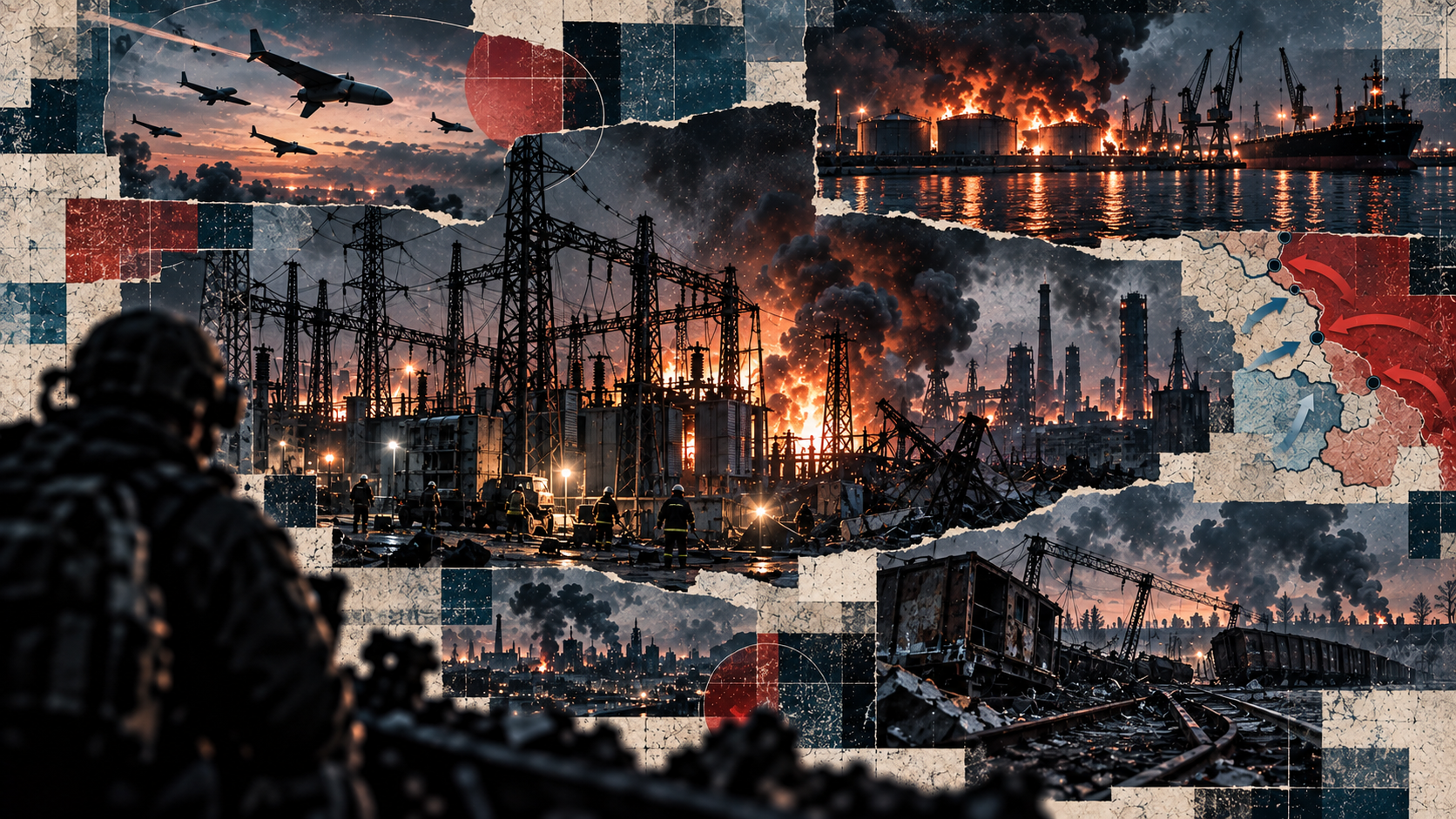
Overnight into Saturday, six ballistic missiles struck Zaporizhstal, the fifth attack on the steelworks since August. The Russian Defence Ministry also reports strikes on a metallurgical plant in Kryvyi Rih, a transformer factory in Zaporizhzhia and a transformer substation in Zhytomyr. Ukraine’s Energy Ministry reports attacks on energy facilities in ten regions and says power has been restored to more than half a million consumers. Zelensky says Russia has attacked the energy sector 76 times over the past week, using nearly 2,700 drones, 1,700 glide bombs and 66 missiles, most of them ballistic. The figures describe a campaign, not isolated strikes.
The centre of gravity has shifted westward. Over the past two nights, jet-powered Geran drones have struck transformer substations, warehouses and data centres in Volyn, Rivne and neighbouring oblasts, and it is through the substations there that electricity from the Rivne and Khmelnytskyi nuclear power plants, as well as imports from Europe, must pass. If they are hit, the grid can be strangled across the entire country without more power stations having to be struck. For drones in such numbers to search for targets in western Ukraine requires guidance far beyond the range of relay stations in Belarus, and much suggests that Rassvet is contributing. Neither side has confirmed it, but the company behind the system displayed ground terminals on 6 October that, according to ISW, could increase range and precision.
In Kyiv, power cuts have become almost permanent, even though Russia has directed most of its strikes elsewhere over the past few days. The Rada has summoned Mayor Klitschko to answer for the city’s winter preparations. He controls neither the transformer substations nor the country’s air defence, and as a political rival of Zelensky he is probably a convenient scapegoat. In Zaporizhzhia, the road across the DniproHES dam was closed throughout Saturday. Authorities cite roadworks as the reason, and the closure was announced the evening before the attacks. What the missile strikes on the city have done to the approaches has not been documented.
Kyiv’s Response: More Than a Thousand Drones Against Russia
Overnight into Sunday, Ukraine sent more than 1,000 drones against Russia, including targets in Moscow and St. Petersburg. In St. Petersburg, the Petersburg Oil Terminal, the Ruchyi depot, a VK data centre, an Ozon warehouse and a bridge were hit. The governor reports one person killed and five injured, while around 20,000 people lost power in the Leningrad region. VK says its services remain operational. The Ukrainian drone company Fire Point claims one of its FP-1 drones was used against the terminal.
The result was probably poor in relation to the effort involved. Even at moderate prices per drone, the bill runs into tens of millions of dollars at a time of acute budget crisis in Ukraine and across the EU. The attack also came despite pressure from Trump to stop refinery strikes, shortly after he announced the energy ceasefire. To Trump, Zelensky now appears to be openly defying him, complicating his attempts to negotiate with Russia. Putin, for his part, has said the strikes on Ukraine will continue, and new large-scale Russian attacks are probably already planned. Such attacks are prepared long in advance, and they will continue regardless of what Ukraine does.
The Starlink Dispute
At the same time, the dispute over Starlink continues. Zelensky says the 161-kilometre-per-hour limit still applies in Ukraine, but not in the EU, where Ukrainian soldiers tested the terminals on Friday. He calls it a “planned operation”. Foreign Secretary Rubio says the United States had no role in the decision and that he is unsure whether Zelensky knows what he is talking about. Musk says that the military and the president decide, while Rubio says Starshield is not available to Ukraine at all. Washington, Musk and Kyiv are giving three different answers.
Either the Americans made a decision they do not want to own, or Kyiv is using the issue for something else. Much suggests that it also serves as an explanation for what is now happening at the front, where Russian and Ukrainian descriptions of the frontline diverge sharply. A narrative of American betrayal is easier to sell than one of collapse in Donbas.
Dobropillia and the Road to Druzhkivka
Gerasimov reported on Friday that Dobropillia had been taken, and the intelligence chief of the 110th Brigade told TASS that a Ukrainian force of around 2,000 men had been encircled and destroyed. According to him, Kyiv initially sent 1,300 soldiers and had to reinforce them along the way. He also says that nearly 500 drone crews were positioned in and around the city, that half were killed and the rest abandoned their positions. Pushilin says the fall cuts ammunition supplies to Kramatorsk. Kyiv’s General Staff denies that the city has been taken. These are Russian claims.
Russian military bloggers describe a pattern consistent with a manpower problem. Oleksiievo-Druzhkivka, the southernmost point of the Sloviansk–Kramatorsk area, is said to have fallen because the Ukrainian command moved troops to Dobropillia, while the village of Velyka Mykhailivka reportedly fell for the same reason to a Cossack unit. Dobropillia had 28,000 inhabitants before the war and Oleksiievo-Druzhkivka 8,000, so the choice was not difficult to understand. Even so, it shows that Ukraine has to move manpower from one place to another against an increasingly powerful opponent that holds the advantage in the air and in drones. The only one of the cities not reported taken is Druzhkivka, which will probably be the next target.
Farther north, the Kharkiv pocket is reported cleared, and Group North is now expected to move towards Velykyi Burluk, which is to be encircled from several directions and then linked with Group West. The objective is Izium, a rail and road hub directly north of Sloviansk, and Balakliia, which covers Izium’s western flank. If Izium falls, Lyman and Sviatohirsk become untenable. When the battle will begin is unclear. The mud season, the rasputitsa, may cause the Russians to wait, but the advance is expected to continue through the autumn and winter, and the likely objective is to reach Izium before spring. The Ukrainians are hurriedly building defences there, but with two groups approaching, logistics failures and power cuts, it is uncertain whether the city can be held as it was in March 2022.
In Zaporizhzhia, Gerasimov reports that Malokaterynivka directly south of the city has been taken. Russian military bloggers say paratroopers crossed the river and that Ukrainian positions collapsed after losses in earlier counteroffensives, while units were moved towards Orikhiv. ISW estimates that Russian forces are 11–12 kilometres from the city itself, not five. The missile strikes on Zaporizhzhia over the past few days look like another round of preparations.
France Burns
While the war continues, Europe is not calm. On Saturday, protests over the cost of living in France turned violent in several cities, and more than 2,400 people have been arrested. In Limoges, masked demonstrators set fire to the 19th-century town hall, and the prefect says the roof has collapsed and two-thirds of the façade is gone. Macron says there is no place for violence in France, while Le Pen warns of a threat to democracy.
The protests are probably not large enough to topple the state or force Macron to resign. They give Le Pen and Rassemblement National a political argument ahead of next year’s presidential election, since she claims she can restore order. At the same time, they increase uncertainty among Europe’s elites at a moment when governments are devoting more attention to Ukraine than to their own problems, and while plans remain to send British and French troops to Ukraine after any eventual ceasefire.
The picture emerging is one in which Russia is maintaining the tempo both in the air and on the ground, while Kyiv has become dependent on decisions in Washington that it cannot influence, and Europe has enough problems of its own.






Se og hør mer
Videoer, klipp og innslag knyttet til temaet.