
The bridge attack: a taboo finally broken
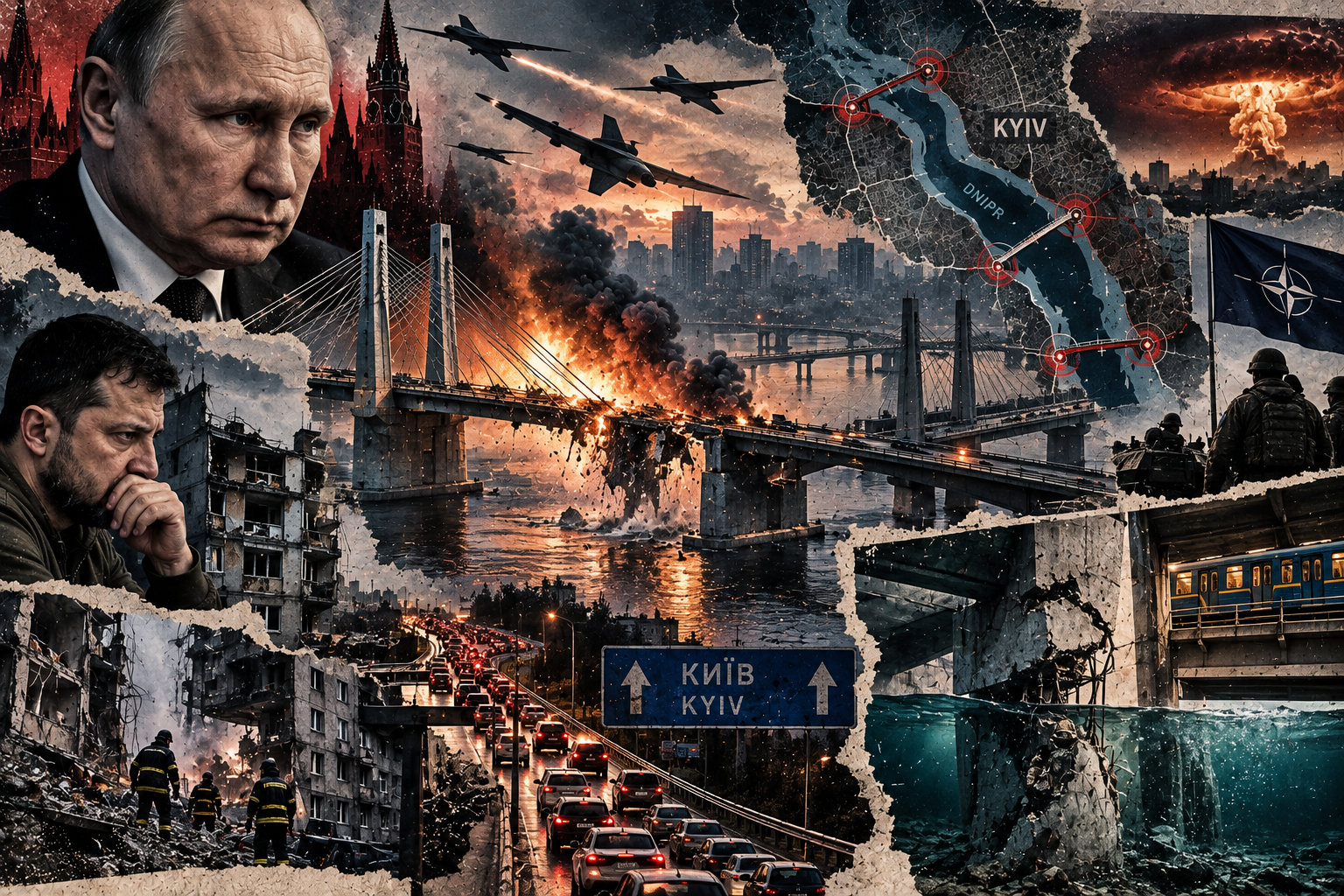
Russian drone attacks on Friday forced the full or partial closure of three bridges over the Dnieper in Kyiv, causing traffic chaos. The South Bridge was hit several times within a few hours, while traffic on the Paton Bridge and the Metro Bridge was restricted. Kyiv mayor Vitali Klitschko said Russia is “tearing Kyiv apart” and that the city must now be put on a war footing. One death was reported after a Russian strike hit a 25-storey residential block the same night.
The Paton Bridge was reopened in both directions later in the day, but the South Bridge remained closed, and video showed a Kyiv hit by long queues and diverted public transport. City authorities said that, among other things, a bridge pier, crash barriers, the road surface and the concrete protection above the metro track had been damaged.
The question of why Russia has not attacked the Dnieper bridges has followed the war since it began in 2022. A large part of Ukrainian military logistics for the forces east of the river – which divides the country almost in two – depends on troops, reinforcements and supplies being able to cross the Dnieper. Many theories have circulated about why Russia held back: that the Soviet-built bridges were too sturdy, that precision weapons would be too costly or inaccurate, or that aircraft sent to attack them would risk being shot down by Ukrainian air defence.
Now the answer is at least partly clear: Russia has started.
An adviser to Zelensky stated as early as 30 September that Russia had begun using a new shaped-charge cutting warhead on jet-powered drones, developed specifically to destroy high-voltage pylons and steel structures on bridges. It has not yet been publicly documented that this particular type of warhead was used against the South Bridge, but the timing and type of target make the connection obvious enough that Ukrainian and Western military analysts are now discussing it seriously.
The Russian Ministry of Defence itself confirmed the attack, stating that a road and rail bridge over the Dnieper in Kyiv “is used by the enemy to move troops and deliver military cargo in support of the Ukrainian force groupings in the Donbas territory” – exactly the military rationale analysts have pointed to for four years.
It is hardly enough damage to bring the bridge down completely any time soon; it was built with large safety margins. But repeated precision strikes on bridge piers, road surfaces, rails or other structural points can render it unusable for heavy traffic without the entire structure having to be destroyed.
There are also reports that the Ukrainian authorities are considering emergency solutions should more Dnieper crossings be knocked out. Pontoon bridges are an obvious option, but the experience from the fighting at Kherson in 2022 showed the limitation: they can keep a supply line alive, but replace only a fraction of the capacity of a permanent bridge.
Kyiv’s isolation in context
The attack on the bridge is the latest link in a pattern that has built up throughout September: first warehouses and industrial facilities, then the railway station and the locomotives connecting Kyiv with the western border, then the internet and data centres, then the power supply itself – power plants, the large electrical substation west of the city – and now the Dnieper crossings.
Individually, each attack may seem limited. Together, they make Kyiv ever harder to govern from, ever harder to supply, and ever harder for Western embassies and advisers to stay in safely.
Even if more bridges were knocked out, it would still be possible to cross the river by boat. But the metro offers no separate underground route beneath the Dnieper: the lines cross the river on bridges, and the South Bridge itself carries both road traffic and the metro. After the attack, metro traffic across the bridge was halted along with road traffic.
The metro’s vulnerability is, moreover, the same as the rest of the city’s: it depends on a stable power supply – exactly what Russia is simultaneously working to weaken.
Zelensky from a bombed school shelter: “He said there are no rules anymore”
In an interview with the Financial Times, given from the bomb shelter beneath a Kyiv school that had been hit by a Russian jet drone the day before, Zelensky claimed that in September Putin ordered his military leaders to abandon earlier restrictions on air strikes and intensify attacks on civilian targets. “He said there are no rules anymore,” Zelensky said, referring to intelligence that allegedly includes intercepted communications between Kremlin officials.
The school’s headteacher said 104 pupils and 60 teachers survived because they reached the shelter before the drone struck; the warhead of around 50 kilos did not detonate. Peskov rejected the accusation, saying Russian forces do not attack schools or hospitals.
There is reason for deep scepticism about the story as Zelensky presents it. An explicit order to deliberately attack purely civilian targets would, if it existed, be a direct order to commit war crimes. At the same time, the Russian Ministry of Defence continues consistently to justify its publicly acknowledged targets on the grounds of military or dual use – such as precisely the bridge, which Moscow says is used to transport troops and materiel to Donbas.
Secondly: if Ukraine really had intercepted Kremlin communications of this sensitivity, it would be extremely unusual to reveal it to a newspaper and thereby alert Moscow that the channel had been compromised.
The more likely picture is the one that has been clear for several weeks: Russia has gradually expanded the range of what it attacks, while its technical capacity has grown – jet-powered drones, specialised warheads, Zircon missiles, more ballistic missiles, a denser satellite network and the emerging Rassvet system. The Financial Times itself describes Rassvet as a Russian-Chinese satellite system under rapid development.
That is an expansion of capacity, not in itself proof that all previous restrictions have been lifted.
Putin at Valdai: a warning of a third world war
“When the world’s leading powers possess weapons capable of destroying all life, or at least bringing the Earth into a catastrophic state, can we be sure these weapons will never be used? Of course not,” Putin said.
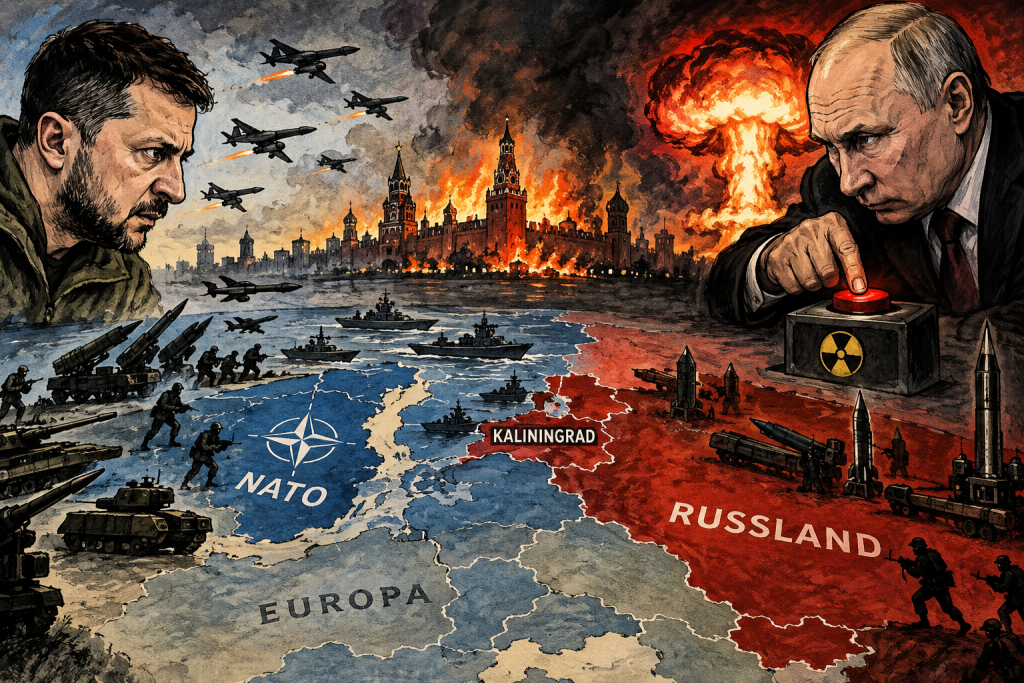
Putin also confirmed that Russia had sent the warning about Kaliningrad, reported yesterday, and described a world in which Western powers, faced with the loss of their dominant position, are turning to greater use of force to try to maintain it – a dynamic he believes is creating an escalation spiral with a real danger of something previously unthinkable: a general war between the great powers.
He was also clear about what a direct attack on Russia would mean. If Russia or Kaliningrad is attacked, Putin said, the question of using “all the weapons our country has at its disposal” will inevitably and immediately come onto the agenda.
It was an unusually grim speech for Putin, who is not normally quite so pessimistic in his assessments. Several explanations stand out.
Professor John Mearsheimer, who recently visited Russia and met a number of Russian officials and other members of the political elite, has said they regard the Ukrainian strikes deep inside Russian territory as completely unacceptable, and that any settlement of the conflict must be such that nothing similar can continue. Mearsheimer himself has written that Russian leaders regard the ever deeper drone and missile strikes as a clear red line.
The crisis in the Middle East and the energy markets also play a part.
But the most obvious explanation is probably the concentrated, simultaneous pressure Russia has been subjected to in recent weeks. CIA Director John Ratcliffe visited Moscow in August to convince the Russians that their military and economic situation would worsen if the war continued. The New York Times described the visit as an attempt to pressure Moscow into a deal before the situation got worse.
The claim that Ratcliffe directly threatened Russia with a Soviet-style economic collapse comes from later British media reports and is far less solidly documented. The same goes for the claim that Foreign Minister Johann Wadephul repeated exactly this threat to Lavrov in New York. What is documented is that Wadephul warned Russia of continued economic pressure if the war continued, while Lavrov later said the German minister read out already known German positions from prepared notes.
In any case, the pressure does not appear to have had the desired effect. Rather than scaring Russia into stopping, it may have reinforced Putin’s view that the West is now fundamentally and permanently hostile, and that the confrontation will continue well beyond the Ukraine war itself.
The front: the Dobropillia cauldron restored, Orikhiv in its final phase
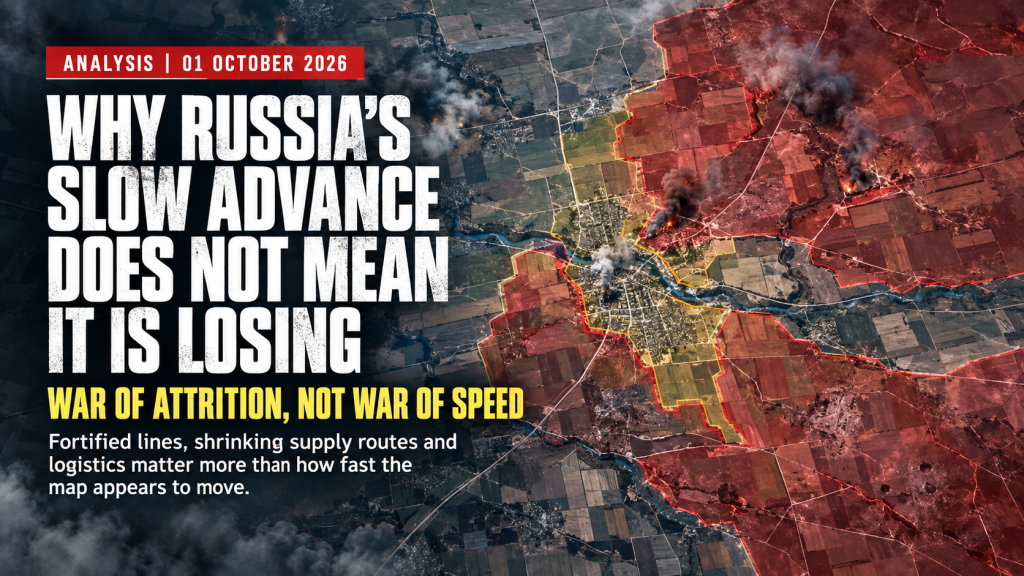
After reports yesterday that Ukrainian forces may have broken through the encirclement at Dobropillia, the Russian Ministry of Defence claims today that the cauldron has been restored – possibly with more Ukrainian soldiers trapped than before, after forces taking part in the breakout attempt themselves became stuck.
At the same time, it is unclear how large the originally trapped force was; Russian figures suggest a relatively limited number. And here the distinction between Russian front reports and what can actually be documented on the map must be maintained: as of 2 October, ISW had seen no evidence confirming the Russian claim that Dobropillia was encircled.
That does not mean the fighting is insignificant. Russian forces are operating both in and north of the town, and the pressure on the Ukrainian lines of communication continues.
In the Zaporizhzhia region, the Russian newspaper Readovka reports that the battle for Orikhiv is nearing its final phase. Readovka describes the northern part of Orikhiv, Preobrazhenka and Omelnyk as the last remaining parts of the old Ukrainian defensive line in the area, and claims that Russian forces have cut the link between the Ukrainian units at Preobrazhenka and Omelnyk.
This is a Russian assessment, and “the battle is almost over” cannot be treated as a confirmed fact. But it is also clear that the Ukrainian defence in the area is under heavy pressure.
In the north-eastern Kharkiv area, Russian forces are also continuing offensive operations, but the claims of a complete collapse of the so-called cauldron north of Velykyi Burluk go further than the independent map material currently shows. On 2 October, ISW recorded Russian attacks in the area, but no confirmed major advances that day.
Diesel and sanctions: a hint of a trade-off
During the Valdai discussion, Putin made a comment that deserves attention: he linked a possible resumption of Russian diesel exports to sanctions relief.
The US and other Western countries are meanwhile trying to dampen diesel prices by releasing strategic reserves. If Russia actually links its export policy directly to sanctions relief, the current energy crisis gives Moscow a bargaining chip it did not have before prices rose.
Kirill Dmitriev, head of the Russian Direct Investment Fund, has moreover been in contact with American officials. It is far harder to document that diesel has specifically been part of a particular trade-off, and it should therefore for now be treated as a possible connection, not an established deal.
Putin also said the domestic Russian market is now supplied with diesel, while this year’s grain harvest of around 140 million tonnes is roughly on a par with last year’s. That reduces agriculture’s seasonal demand and gives Russia greater freedom to decide when exports might reopen.
Bryansk and Sumy: a possible warning of the next phase
Russian and private sources report a build-up in the Bryansk region and speculation about a later operation against the Chernihiv region. There is as yet no independent documentation making it possible to establish that such an operation has actually been decided.
In the Sumy region, developments are more concrete. Geolocated footage shows Russian infiltration operations east of Sumy, and the Russian Ministry of Defence claimed on 2 October to have taken Mala Rybytsia. It is still a big leap from there to an assault on Sumy itself, and the claim that such an attack is imminent goes further than the open documentation.
The strategic logic is nonetheless clear. Sumy lies on the main axes south towards Kyiv, while Bryansk lies north of the Ukrainian capital. Should Russia at a later stage increase pressure from both the Sumy and Chernihiv directions, it would force Ukraine to spread its forces far beyond the Donbas front.
And if Kyiv at the same time loses capacity in rail, power supply and Dnieper crossings, the city’s role as a political and logistical centre becomes far harder to sustain.
Conclusion: a world increasingly reminiscent of 1962
Taken together, the picture emerging is of a world entering a long and grim period of great-power tension – a situation that in several respects resembles the late 1950s and early 1960s, which culminated in the Cuban Missile Crisis of 1962.
The difference is that today’s global backdrop is in several ways more fragmented: war in Ukraine, crisis in the Middle East, pressure on the energy markets and an increasingly explicit discussion of what will happen if NATO and Russia end up in direct conflict.
Putin’s message at Valdai was not that nuclear war is desired or inevitable. It was that an escalation spiral can reach a point where control is lost, and that Russia will make its entire arsenal available if the country is attacked.
Meanwhile, the conventional war goes on. Dnieper bridges are being attacked for the first time in Kyiv. The power system is being hit from ever more angles. The front is still moving, even if Russian claims of certain encirclements and breakthroughs go further than the open map material can yet confirm.
Neither side appears to want a direct great-power war.
But the distance between a war that was meant to be kept limited to Ukraine and a far larger confrontation between Russia and the West has become noticeably shorter.




Se og hør mer
Videoer, klipp og innslag knyttet til temaet.