
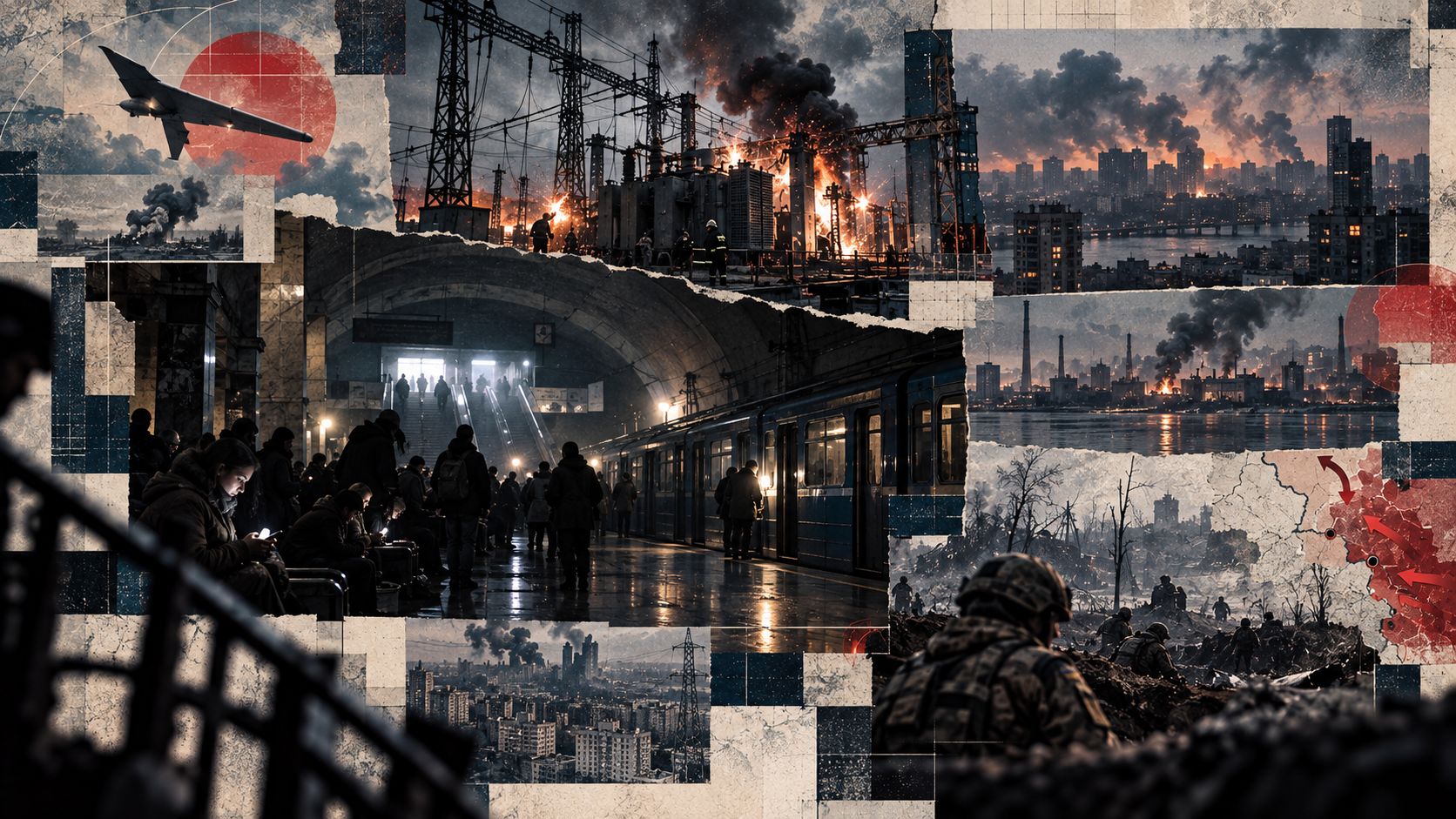
Kyiv: The Power Goes Out, the Metro Stops
The Russian attacks on Kyiv have in recent days shifted from the bridges to the systems that keep the city itself functioning. After a week in which the southern and northern bridges across the Dnipro have been among the principal targets, the large Kyivska substation west of the capital was again attacked with Geran drones. The core of the facility is still protected by a massive concrete shield, but photographs now circulating show extensive damage to the structures around it. According to reports, almost every part of the substation outside the protected core was hit, and the facility was out of operation for several hours. The consequences were immediate: large parts of Kyiv lost power, the metro stopped, and the water supply was also affected. Kyiv Metro confirmed that train services and escalators temporarily stopped as a result of voltage drops.
It is precisely the combination that makes the development serious. The railway is already under pressure after months of attacks on locomotives and tracks, the bridges across the Dnipro have repeatedly been hit, fuel facilities and warehouses have been attacked, and now it is becoming clear that the power grid in the capital can be put out of action without the Russians even using the weapons best suited to breaking through the concrete shield around the substation. Russia has stepped up its attacks on Ukrainian energy infrastructure and fuel facilities in recent weeks. There are also unconfirmed reports that Russia is using specialised Geran-4 drones with warheads designed to cut the power lines running into and out of the facility. If true, the objective is not merely to damage the transformers themselves, but to turn repairs into a continuous task in which every restored connection can be cut again.
At the same time, Russian drones have struck buildings linked to the SBU security service in central Kyiv. One Geran drone is said to have crashed inside the grounds of the SBU academy, while other buildings linked to the service were attacked the night before. The extent of the damage is unclear, but the direction is harder to ignore: the bridges restrict movement, the substation hits the power supply, the metro stops, and the security apparatus comes under pressure at the same time. No single target decides anything on its own. It is the cumulative effect that is beginning to make the city increasingly difficult to run.
The Concrete Shield Holds — for Now
The most interesting thing about the substation is actually what Russia has not yet done. The Russian attacks have so far been carried out mainly with Geran-4 and Geran-5 drones, weapons with relatively small warheads that are poorly suited to penetrating thick concrete structures. Russian media now claim that a small number of Kinzhal missiles, supported by drones, would be enough to break through the shield. Whether that estimate is correct, we do not know. What is clear, however, is that Russia has used far more powerful weapons elsewhere and has so far chosen not to do so here.
That fits the pattern seen with the bridges. First come the weaker attacks. Ukraine repairs, reroutes and reveals how the system functions when something fails. Russia then learns which parts are actually critical, where the backup connections are, and where the repair resources come from. The attacks on the Kyivska substation may therefore be less failed attempts to destroy the facility than a gradual mapping of what must be taken out if Russia later wants to make the blackouts permanent.
The same applies to the bridges. The status of Kyiv’s northern and southern bridges remains unclear, but Ukraine now knows they can be struck again at any time. Over the past week, Russia has expanded its air campaign to bridges across the Dnipro in both Kyiv and Zaporizhzhia. Russia has meanwhile demonstrated in Zaporizhzhia that it is willing to use heavy precision bombs against bridges when it considers this necessary. If the objective is to make Kyiv increasingly difficult to supply, move through and administer, Russia does not need to destroy everything at once. It is enough to ensure that more and more systems never have time to be properly repaired before the next strike comes.
Zaporizhzhia: FAB-3000 Near the City
Zaporizhzhia was also attacked again. This time, Russian aircraft reportedly struck targets in the northern part of the city, near the large hydroelectric facility on the Dnipro, although it is not yet clear exactly what was destroyed. At the same time, the Russian Defence Ministry stated that two FAB-3000 glide bombs were used against a temporary staging area belonging to Ukraine’s 65th Mechanised Brigade near Orikhiv. That means six tonnes of bombs against a single target, and shows how far Russia’s use of heavy glide bombs has now developed.
It is also worth noting what this says about the distance to Zaporizhzhia city itself. Russian aircraft no longer need to operate right up against the front line to deliver weapons of this type, and strikes against targets near the city are becoming steadily heavier. A few days ago it was the bridge across the Dnipro. Now there are new bombing attacks against installations in the northern part of the city and against Ukrainian units farther south. If this continues, the question becomes less whether Zaporizhzhia will be subjected to a systematic air campaign, and more how far that campaign has already progressed.
At the same time, the Russian Defence Ministry itself has begun describing the war differently. Deputy Defence Minister Yunus-bek Yevkurov recently said that the army has abandoned several of the limitations that characterised the original “special military operation”, and that Russian forces are now training and operating for a conventional war. In practice, it is the same development we have seen in the air: larger bombs, more targets, fewer restrictions and an increasingly broad campaign against Ukraine’s logistics, energy system and military industry.
Zelensky Begins Looking Westward
In the middle of this, Zelensky has once again criticised Europe for not doing enough, and is also reported to have expressed dissatisfaction with the United States. The problem is that it is becoming increasingly difficult to see what the West can actually deliver that would change the situation. Friedrich Merz visited Kyiv with political assurances and money, but without new air-defence systems. The NATO delegation that arrived shortly afterwards promised continued support, but it too brought neither new Patriot batteries nor large stocks of interceptors. Zelensky has again asked NATO for concrete assistance with air defence, particularly systems capable of intercepting ballistic missiles.
Kaja Kallas has already said that attempts to persuade European countries to give up their remaining air-defence systems have met resistance. It is not difficult to understand why. The same governments telling their own populations that Russia could attack NATO are simultaneously being asked to send away the systems they need to protect their own cities. Ukraine’s shortage of air defence, particularly Patriot interceptors, is now being described as critical. The United States is not producing enough interceptors to replenish its own stocks, Ukraine’s and Europe’s simultaneously. Even if Europe were to send what remains, a few extra batteries and missiles would be unlikely to alter the balance in the face of hundreds of drones, cruise missiles, ballistic missiles and glide bombs.
That is why Zelensky’s complaints now have a different tone than before. The question is no longer simply whether the West is willing to help. It is whether the West still possesses the military resources Ukraine needs, in the quantities required, without emptying its own stocks in the process. And if the answer is increasingly no, then assurances of support become primarily political.
Kharkiv: The Pocket Appears to Be Gone
On the ground, developments are at least as serious. In Dobropillia, Russian forces continue their advance, while the Ukrainian counterattack by the 12th Azov Brigade appears to have lost momentum. Russia’s Defence Ministry claimed on 8 October that it had taken control of another 103 buildings and advanced in the central and northern parts of Dobropillia. Around Lyman, there is still little to suggest that Operation Vivaldi has achieved the breakthrough it was supposed to deliver. But the most interesting development is farther north, in the Kharkiv region.
Russia has published video of soldiers in the northern parts of the area previously described as a Ukrainian pocket, and it is beginning to look as though that pocket has now effectively been cleared. At the same time, heavy glide bombs are being used against Ukrainian positions near Prykolotne south of the area, while Russian forces appear to be preparing further operations toward Velykyi Burluk. The Russian Defence Ministry claimed on 8 October that its forces were continuing to compress the encirclement in northeastern Kharkiv region while simultaneously fighting for Prykolotne. There are also reports of simultaneous Russian movements in the Sumy and Kharkiv regions, which may indicate that Ukrainian defences are beginning to give way in several places at once. Russia claimed the following day to have taken Kiyanitsa in Sumy region while continuing to press in northeastern Kharkiv.
It is too early to conclude that this is the result of the bridge strikes around Kyiv. Ukraine still has stockpiles and supply bases in the northeast, and the front is not supplied through a single route. But the timing is difficult to ignore. As traffic across the Dnipro becomes more difficult, the railway is attacked and warehouses are systematically struck, problems begin to appear precisely in the areas farthest to the east and northeast. The Russian Defence Ministry also released footage on 9 October of a strike it said had destroyed a bridge over the Oskil River in Kharkiv region. If this continues, the Kharkiv region may become the first place where the effects of the broader logistics campaign become visible on the front itself.
No Winter Pause This Time Either
There is still an assumption that Russia must achieve its objectives before winter because operations will then stop. The war so far shows the opposite. It is the autumn and spring mud seasons that make movement difficult. Once the ground freezes, offensives continue. Bakhmut, Marinka, Avdiivka and several other major operations took place through the winter months.
The difference this time is that Ukraine is entering winter with an energy system under far greater pressure than before, while the railway, bridges, warehouses and military industry are being struck in parallel. Ukrenergo introduced new emergency power cuts on 9 October as a result of damage to the power system following the Russian attacks. If the Kyivska substation is eventually put permanently out of operation, this winter’s blackouts could be of an entirely different character from the temporary outages of the previous year. That gives Russia an incentive to increase the pressure as the cold arrives rather than reduce it.
Diplomacy Disappears as the Pressure Increases
At the same time, there are fewer and fewer signs that anyone is preparing a political way out. Dmitry Peskov has joined Marco Rubio in assessing that Russia and Ukraine remain far apart, while the Kremlin rejects the idea that a summit is imminent. Contacts still exist between Russian and American figures regarding future economic cooperation, but there is no real peace process. US envoys meanwhile met Ukrainian representatives in Miami to discuss new proposals and possible frameworks for an agreement. In Europe, there is likewise no sign that governments are willing to discuss the Russian demands that might previously have formed the basis for an agreement.
That makes the developments of the past few days far more serious than another wave of drone attacks would suggest. Russia does not appear to be using its military gains to force a rapid negotiation. On the contrary, Moscow appears to have concluded that time is working in Russia’s favour, and that it can achieve more through continued military pressure than through compromise now.
Kyiv therefore faces a winter in which the power is already failing, the metro has stopped, the bridges can be struck at any moment and the front in the northeast is showing signs of weakening. Kyiv’s own authorities have described the situation after the latest attacks as serious enough that some residents have been advised to consider temporarily leaving the city if they are able. Western governments continue to promise support, but increasingly lack the concrete systems needed to stop the trend. And while everyone waits for the next diplomatic initiative, Russia continues doing what now appears to be its actual strategy: not one decisive blow, but the gradual dismantling of the systems that make it possible for Ukraine to continue the war.





Se og hør mer
Videoer, klipp og innslag knyttet til temaet.