

The Diesel Deal: Much Noise, Little Substance
The reaction to the agreement between Trump and Putin has been far more dramatic than the agreement itself would suggest. The quantities of diesel are small, estimated at between three and nine days of US consumption, with a value of between $3 billion and $7 billion. That does not even cover a tenth of Russia’s budget deficit of around $60 billion. The United States had already eased similar licences in March, after the Strait of Hormuz was closed, and allowed them to be renewed for several months. The Biden administration publicly asked Ukraine in 2024 to stop the refinery attacks, while US intelligence was simultaneously providing targeting support to parts of the campaign.
What distinguishes this case is not the agreement, but Zelensky’s reaction. He himself has driven the narrative of betrayal, as though Ukraine has a veto over how the United States conducts trade with other countries. Trump’s response was moderate by his standards: he said Zelensky had rejected every opportunity to make a deal, and that perhaps it was time for a new leader. Many Ukrainians agree. Zelensky refuses to hold elections, calls anyone who suggests them rude, and at the same time demands an endless supply of money and weapons.
After Trump said this, Zelensky reportedly called Merz, Macron and Burnham. All are said to have reiterated their support. That is probably the main reason he remains in office: Europe is paying, and Europe also supports the drone offensive against the wishes of the United States. Elon Musk is also said to have sided with Trump. If true, it is unlikely that Ukraine will gain access to the military version of Starlink.
Kyiv: “Survival Mode”
Kyiv Mayor Vitali Klitschko said in an AFP interview that the city has entered “survival mode”, and advised residents with relatives outside the city to consider leaving temporarily. He stressed that this is not an evacuation order. “Putin’s goal is for all of us to leave and hand over the cities and the country to him,” he said. Any evacuation would in any case have to be approved by Zelensky, and Klitschko is hardly in his good graces. Even so, it is remarkable that the mayor of the capital is speaking in these terms.
Russia attacked Kyiv with drones again overnight into Sunday, and power cuts in the city are becoming recurrent. The outages are probably being caused by systematic attacks on the power lines, often at night and outside the city, where nobody films them. Russia has learned how the Ukrainian grid works.
A daylight attack a couple of days ago struck buildings belonging to the SBU security service with a level of accuracy that reportedly alarmed the Ukrainians. They examined the remains of the drones and found no Rassvet terminals. The explanation is probably simpler than they think: the drones attacking Kyiv are controlled through relay stations along the Belarusian border and through a mesh network in which the drones pass signals between one another. Kyiv is not far from the border. The Ukrainians nevertheless suspect Russian agents inside the city, and an intensive hunt is probably under way. Whether the agents exist or not, the search itself increases the paranoia. Only two German Gepard anti-aircraft vehicles are reportedly defending the bridges against the drone swarms.
Drones That Cannot Be Jammed
A Ukrainian analysis from the blog Events in Ukraine describes a rapid evolution. According to the analysis, Russia has introduced its own jet engine to replace the Chinese one used in the Geran-4 and Geran-5, giving a claimed top speed of around 800 kilometres per hour. Ukrainian military intelligence confirms that the Chinese Telefly engine in the new Geran-4 has been replaced by a Russian-produced variant from Alabuga. According to the same analysis, current Ukrainian interceptor drones fly at around 300 kilometres per hour, while the new jet-powered interceptors under development are expected to reach around 600.
Even more important is the guidance system. The drones are said to have a terrain-following navigation system called Susanin, named after a 17th-century Russian hero, together with artificial intelligence linked to optical sensors. If the drone loses contact with the operator in the final phase, it finds the target itself. That means jamming no longer works as effectively as before. Susanin compares images from the drone’s optical sensor with pre-stored reference images, allowing the drone to navigate without relying on satellite signals. According to the analysis, the Rassvet system is already partly operational with 31 satellites and has been tested for civilian purposes in Russia. Ukrainian intelligence has confirmed that Russian forces have already used Rassvet links over Ukraine. A couple of days ago, Geran-5 drones reportedly struck Lviv, far beyond the range of the relay stations in Belarus. Mercouris says he is uneasy about autonomous drones selecting targets on their own, but believes this is the future of warfare.
Eric Schmidt said in a lengthy interview with The Economist that Russia has at least achieved technological parity in several areas of the drone war. He said the Russians were supposed to be the lumbering giant, but have proved just as innovative as the Ukrainians. Ukrainian fighter aircraft are now using Soviet-era R-60 missiles, some manufactured in the 1960s, to shoot down drones. At the same time, the Azov movement has begun complaining that the Russians are winning the battle for FPV operators. That is hardly accidental: Zelensky and Fedorov channelled the money into Firepoint and the drone offensive against Russia, rather than into the drones soldiers need at the front.
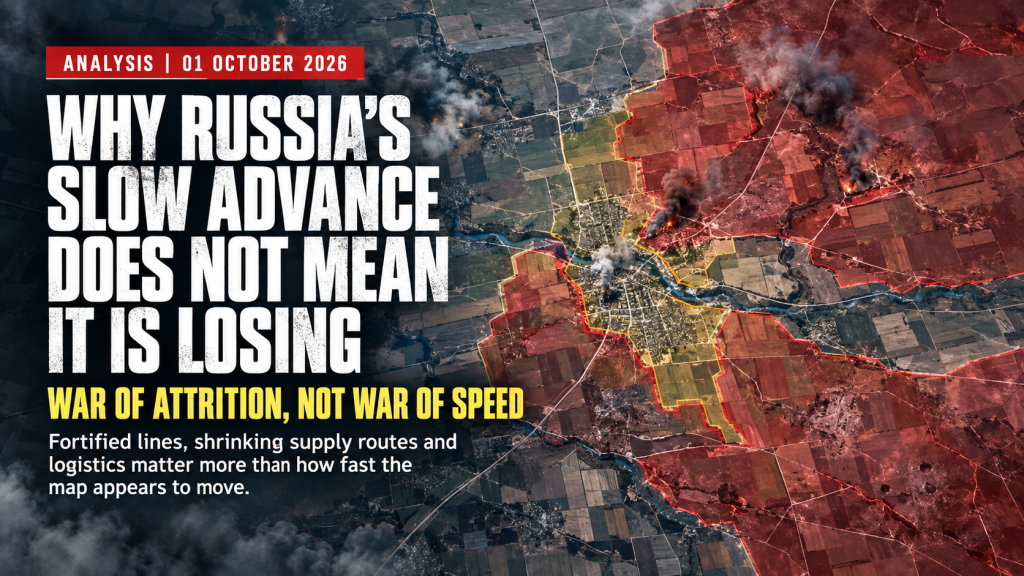
The Front: The Cauldrons Are Closing
In northeastern Kharkiv region, Russia reports two more villages taken, with only four remaining. The cauldron is effectively over. The next operation is directed toward Velykyi Burluk, which is going to fall, followed by a push south toward Izium and Balakliia. That is when the crisis begins for Ukrainian forces in Sloviansk and Kramatorsk. One report says as many as 70,000 Ukrainian soldiers are positioned there, with some estimates even higher.
Around Lyman, Biletsky’s offensive has been reduced to reaching the Yerobets River, and it appears set to end as another meat grinder. Around Dobropillia, Russia reports two more villages taken, suggesting that Azov’s counterattack has been beaten back. According to the Russian Defence Ministry, the western parts of the city are now being cleared. Everything suggests that Ukrainian resistance will soon be over.
Rumours that Surovikin is back are supported by one source, but remain unconfirmed. According to that source, he is leading a group of around eight generals, while Gerasimov retains overall command.
Trump Can No Longer Afford Ukraine
Trump will probably lose control of Congress in the November midterm elections, and will also devote most of his attention to Iran. Putin met Iranian President Pezeshkian in Ashgabat and is said to have conveyed his peace proposals to Trump during the diesel conversation. Trump probably did not listen. At the same time, the Houthis are now striking Riyadh with missiles. The possibility of a peace agreement in Ukraine is probably gone. Trump failed to bring Zelensky along when he was at his strongest, and he will not manage it now.





Se og hør mer
Videoer, klipp og innslag knyttet til temaet.